The Space Marines of Warhammer 40K.
The Space Marine is the image everyone keeps from Warhammer 40K: a two and a half metre silhouette in power armour, barely human, standing where a whole company would fall. It is also the rarest and most expensive weapon the Imperium has.
Here is what they really are, how one is made, the best known chapters, where the primarchs they descend from come from, what the transformation costs, and how to play one without flattening the rest of the table.
What is a Space Marine?
A Space Marine, or Adeptus Astartes, is a human turned by surgery, genetics and conditioning into a war machine. They barely sleep, survive wounds that would kill ten men, breathe toxic atmospheres and live for centuries if the battlefield lets them. Their ordinary strength is enough to break an armoured door.
Yet there are very few of them. Roughly a thousand chapters of a thousand warriors each, for an empire of a million worlds: on the scale of the galaxy, a handful of men. They are not sent to hold a front, they are sent to strike the exact point that tips a war, and then leave.
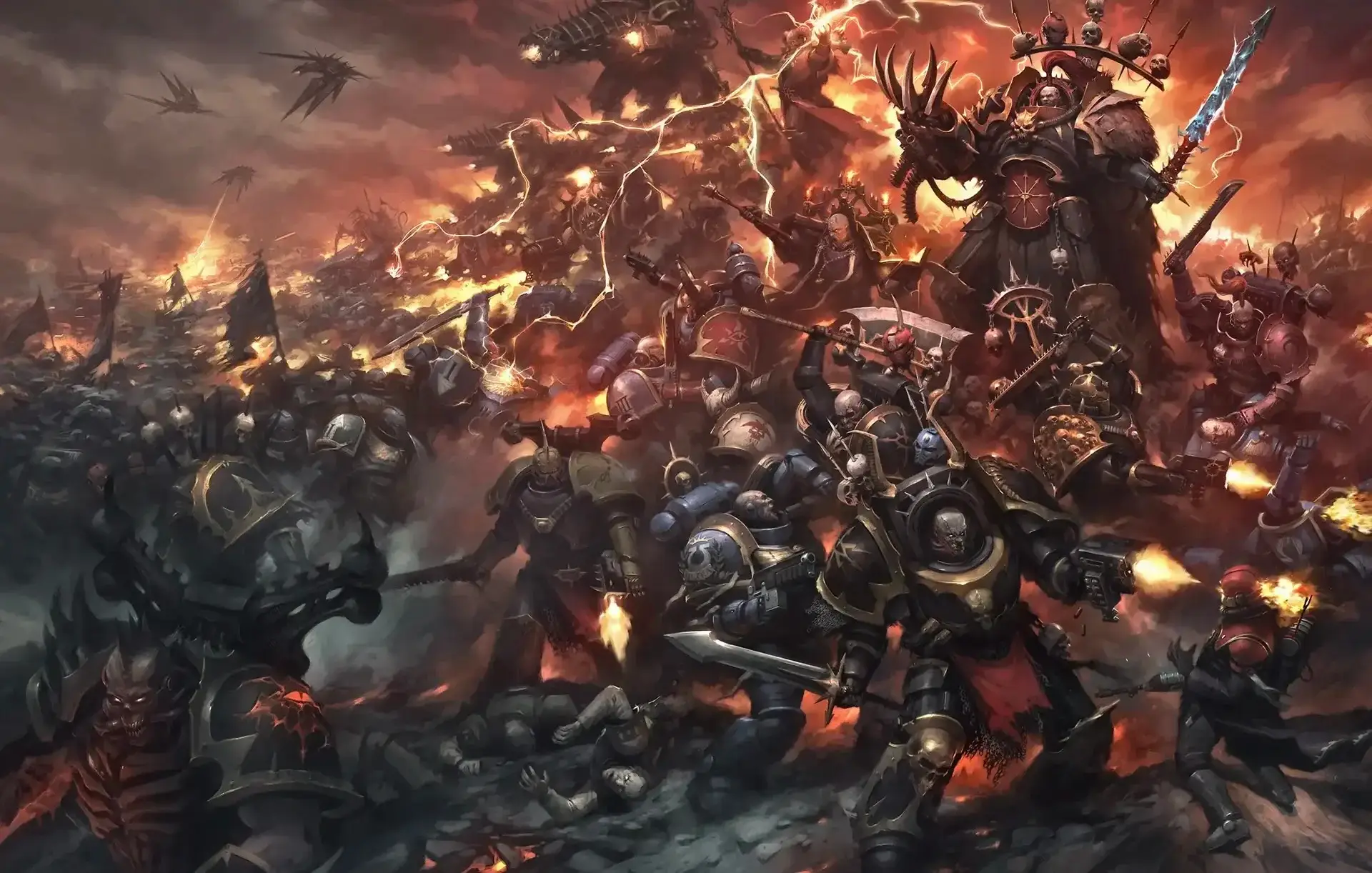
How a Space Marine is made.
Chapters take adolescents from planets where surviving is already an achievement. Most candidates die before the first operation.
Each chapter keeps a genetic legacy tracing back to its primarch. It passes from one warrior to the next, and its purity is watched closely.
A second heart, reinforced bones, blood that clots instantly, lungs that filter poison. Every implant can kill the recipient.
Learning comes through hypnosis and repetition until the chapter's doctrine becomes reflex. Whatever civilian remained disappears there.
A final implant beneath the skin links the body to the power armour. The warrior does not wear it, they inhabit it, and almost never leave it.
The chapter becomes the only family, with its relics, its rites and its dead. Nobody leaves this order, they die in it.
The best known chapters.
The model chapter, disciplined and administering a realm of its own. They wrote the manual the others follow, or refuse to follow.
Artists as much as warriors, haunted by a thirst inherited from their dying primarch. Their nobility lies in fighting themselves.
Warriors of the cold, attached to oaths spoken aloud and thoroughly indifferent to the official manual.
For ten thousand years they have hunted brothers turned traitor, without ever admitting it to anyone. The silence costs them more than the battles.
Peerless smiths, they take protecting populations seriously, which is rare enough to make them an exception in the Imperium.
They hold no world of their own and have travelled for millennia, carried by burning faith and total distrust of sorcery.
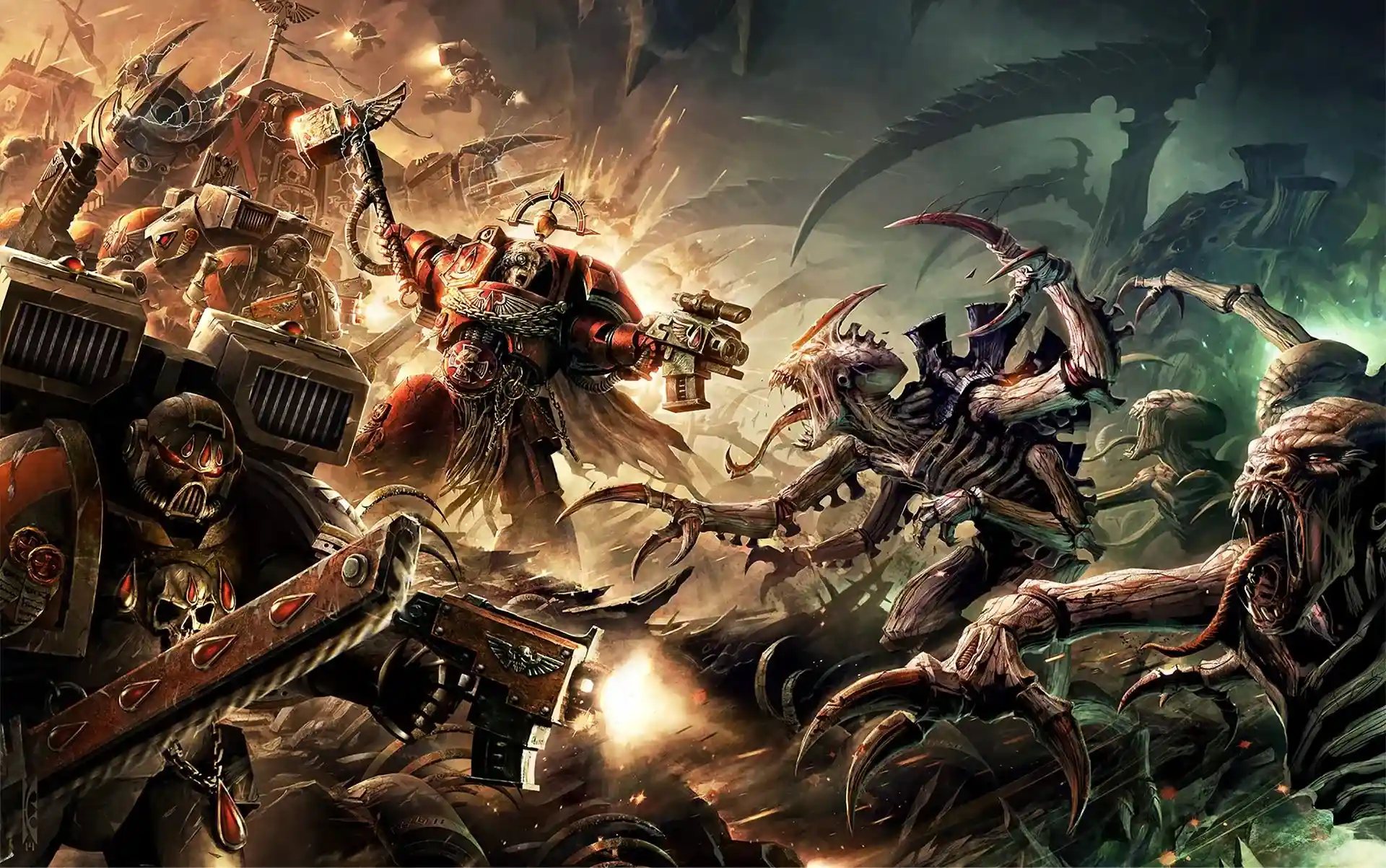
The primarchs, at the origin of it all.
The Emperor made twenty sons, shaped to command his legions. Scattered across the galaxy by the Warp before being found one by one, they became superhuman generals, each with their own temper, obsessions and flaws. Two were struck from the records and nobody says why.
Every Space Marine descends genetically from one of them, and inherits their strengths along with their faults. That is why one chapter is methodical, another uncontrollable, a third eaten by a curse in the blood. When half those sons turned on their father, the legions followed, and the Imperium never recovered.
What the transformation really costs.
Becoming Astartes means losing nearly everything that made you someone. The recruit forgets their family, their world and often their name. Their body no longer knows ordinary fatigue, but it no longer knows rest, appetite or desire either. Those who watched them grow up would not recognise them, and they would not try to be recognised.
That is what makes these characters worth playing, provided you look past the armour. A Space Marine faced with a terrified civilian, an absurd order or a brother who doubts is worth far more at a table than a stack of bolters. The question in play is not what they can destroy, but what human part is left.
Playing them at your table.
Wrath & Glory prices the Astartes high. Without that safeguard, the rest of the group becomes an audience rather than players.
All Space Marines, all from one chapter: the table finds its balance and the tone becomes that of the novels.
It sets the colour, the rites, the rivalries and half the dialogue. It is the choice that shapes an Astartes campaign most.
Wherever they land, people step aside, fall silent or kneel. Playing that reaction makes the character far more impressive than a sheet does.
You do not send an Astartes to investigate an office. Hand them the decisive strike, the siege, the boarding action, the last line.
A memory from before, a doubt, a lost brother. Those cracks make the best scenes, far more than the weapon list.
Running a squad online.
An Astartes game runs on strong images: a boarding ramp, a city in flames, a line of ceramite facing a tide. Describing all of it in words alone, session after session, takes energy the game master would rather spend on the story.
Tomeus brings the backdrop, the music, the sheets and the dice into one window. You prepare your scenes ahead of time, switch image and mood in one click, and your players join from home with their character in front of them, with nothing to install.
Go further with Warhammer 40K.
How to start playing the Warhammer 40K RPG?
Wrath & Glory or Imperium Maledictum, dice, character creation and a first session: the guide to getting started with the Warhammer 40K roleplaying game.
The basic rules of Warhammer 40K
The dice and symbols of Wrath & Glory, the d100 of Imperium Maledictum, the pools, combat and corruption: the rules of the 40K roleplaying game explained.
The lore of Warhammer 40K
The Imperium and its institutions, the Space Marines, the Inquisition, Chaos and the xenos, the Heresy and the Warp: the lore of Warhammer 40K explained for your table.
The archetypes of Warhammer 40K
The archetypes and roles of the 40K roleplaying game explained: Space Marine, trooper, tech-priest, psyker, savant and penumbra, factions, and how to choose yours.
Go further with tabletop RPGs.
How to Play a Tabletop RPG: the Beginner's Guide
How a session unfolds, what the game master does, dice, character sheets and how to play a tabletop RPG online. A complete guide for beginners.
How to Find Players for a Tabletop RPG
Game shops, clubs, conventions, Discord, online listings: where to find players for your tabletop RPG and how to write an ad people answer.
How to Prepare a Tabletop RPG Campaign
Setting, central stake, factions, NPCs and per-session prep: the method to build a tabletop RPG campaign without writing everything in advance.
How to Create a Tabletop RPG Character
Concept, class, ability scores, skills, backstory and bonds: the full method to create a tabletop RPG character who will carry a whole campaign.
Frequently asked questions.
Are Space Marines still human?
Biologically they start from a human, but nineteen implanted organs, the conditioning and centuries of war move them permanently away from what they were. They reason, remember and hold loyalties, but their relationship to their body, to fear and to death has nothing in common with ours.
How many Space Marines are there?
Around a thousand chapters of a thousand warriors each, a handful of men across an empire of a million worlds. That rarity is exactly what gives them weight: their arrival somewhere means the Imperium considers the situation beyond saving by other means.
How do you play one without unbalancing the table?
The simplest answer is for everyone to play one, in the same squad and the same chapter. Otherwise use the power tiers of Wrath & Glory, which price the Astartes far higher at creation. A third option is to keep them as a game master character, occasional and impressive.