
The Great Old Ones of Call of Cthulhu.
Cthulhu is not the highest power in the game that carries his name, and he is not a god in the usual sense either. The Mythos lines up entities from elsewhere, with no morality and no intentions towards us, that humans called gods for lack of a word able to describe them.
Here are the tiers of that pantheon, the Outer Gods and the Great Old Ones, their cults, what a single appearance costs in Sanity, and how to bring them to your table without burning through their effect in one session.
Three tiers in the pantheon.
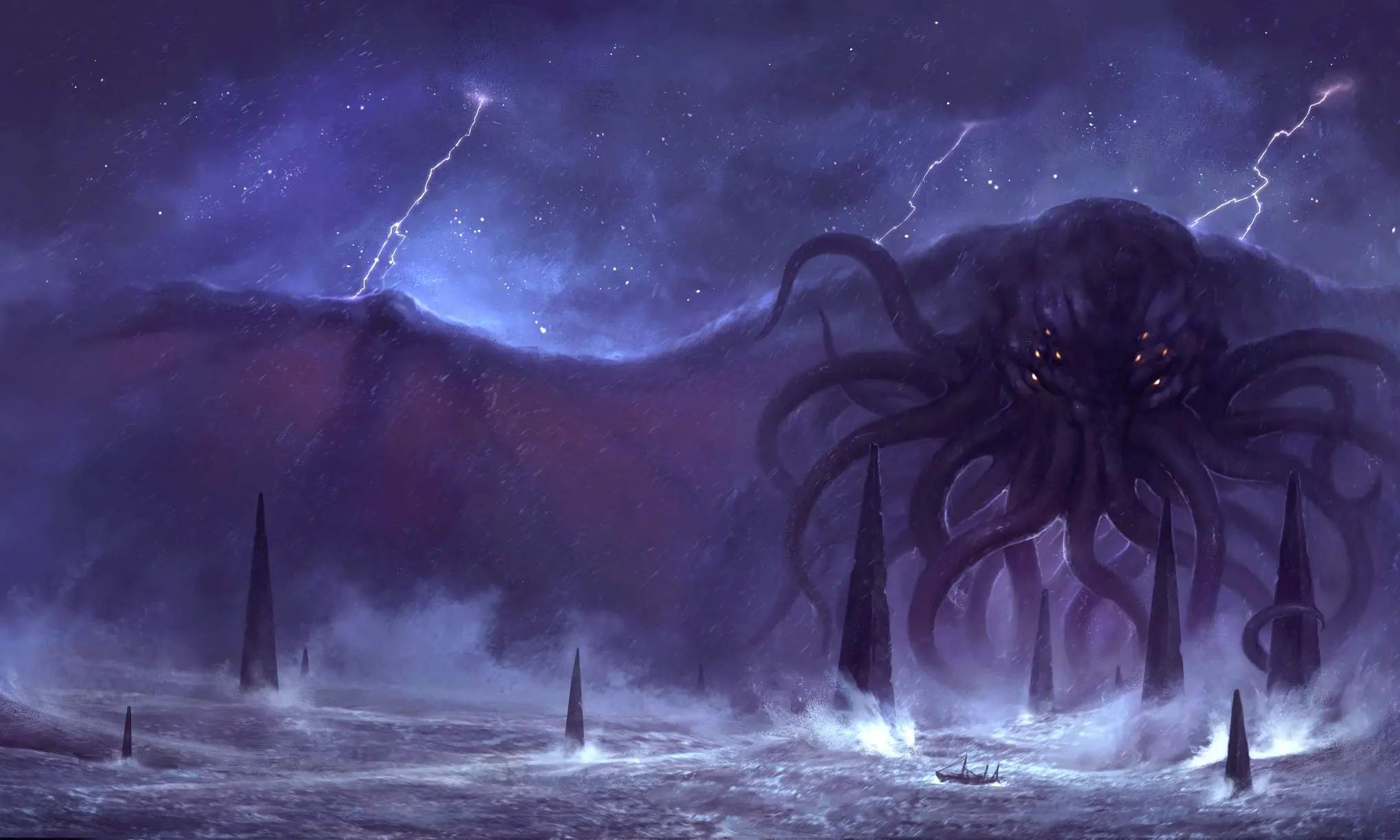
The Outer Gods sit at the top: Azathoth, Yog-Sothoth, Shub-Niggurath, cosmic powers that know neither good nor evil, and to whom humanity matters no more than a bacterium. They do not hate us, which is considerably worse than hatred.
The Great Old Ones come below: they have a body, a place, a prison, a sleep they will eventually wake from. Cthulhu waits at the bottom of R'lyeh, Ithaqua walks the wind of the far north. Some texts also mention Elder Gods opposed to those above, but Lovecraft never wrote that: it came from the writers who followed him, and plenty of Keepers drop it to keep a universe where nobody is watching over us.
The Outer Gods at the top.
It has neither intent nor awareness, which makes it impossible to bargain with. Its waking ends the universe, so it is never the stake of a scenario.
It exists everywhere and in every era at once, which makes it a passage. Cults turn to it to open what should stay shut.
Fertility with no limit and no purpose, worshipped in the countryside as much as in cities. Its young make excellent opponents, which it never will.
The only one that speaks to us, in a thousand human forms, and the only one that means us harm on purpose. The ideal antagonist for a whole campaign.
It has no shape, only a view: to see it is to understand the structure of space. That understanding costs your mind.
An anonymous court that dances and pipes around Azathoth. They mostly exist to remind you the pantheon has no bottom.
The Great Old Ones still sleeping.
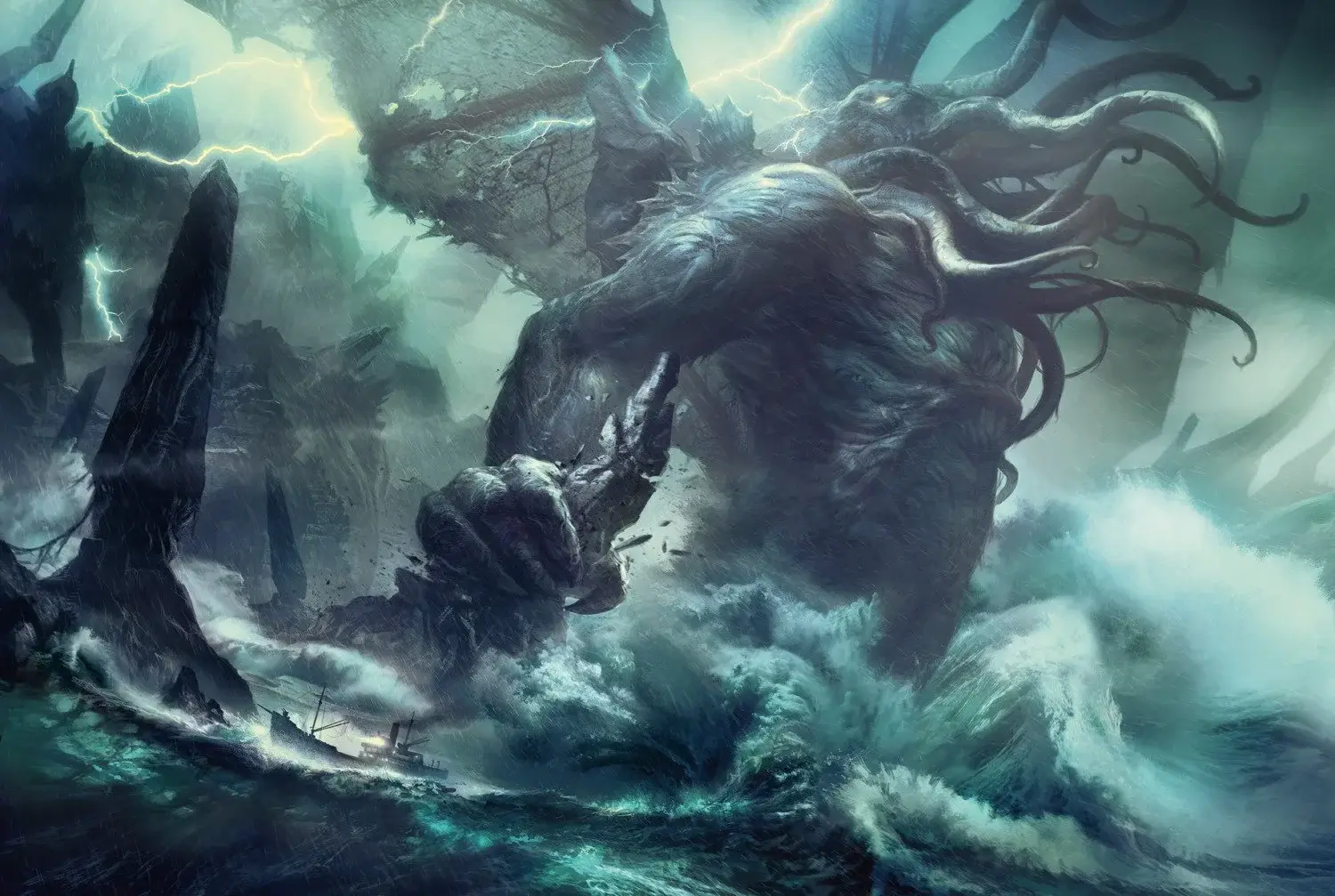
It sleeps in a sunken city and its telepathy reaches artists and madmen. Seeing it costs more Sanity than any other encounter.
Saying its name three times draws its attention, which is a scene in itself. The King in Yellow and Carcosa open the way to a more theatrical horror.
Worshipped by the Deep Ones, they are close enough to the world to actually appear. The most playable divine couple in the whole Mythos.
Well fed, lazy and settled in a cavern of N'kai, it does not travel. Its faithful do all the work, which suits an investigation perfectly.
It carries victims into the sky and returns them frozen, weeks later. Perfect for a closed room scenario in the far north.
Seeing its image, even in a photograph, petrifies the body without killing the mind. The victim stays conscious inside, which says a great deal about the Mythos.
The cults, the real danger.
A Mythos deity almost never turns up in person. What your investigators meet are humans: a family of local worthies, a circle of academics, an entire village that has not been quite human for three generations. The cult is what makes the Mythos playable, because you can talk to it, follow it, infiltrate it and fight it.
Every cult wants something concrete with a date on it: a conjunction of stars, a birth, a gate to open before dawn. That deadline is what gives an investigation its rhythm. Investigators never save the world, they only push the moment back, and that tiny victory is exactly what the game offers.
Meeting a god, and what it costs.
The rules treat these entities as natural disasters rather than opponents. Seeing a Great Old One costs a Sanity loss an investigator has almost no chance of absorbing, and the madness that follows is not the Keeper punishing anyone: it is the normal reaction of a human mind to something that should not exist.
Combat is not designed to be won. A deity is never killed, it is driven back, put to sleep again, sent through a gate to the other side, and always at full price: one character dead, another committed, knowledge nobody recovers from. Cthulhu Mythos is in fact the only skill that improves by damaging whoever learns it, since every point gained removes a point from maximum Sanity.
Bringing them to your table.
A god implied stays terrifying, a god shown becomes one more monster. The best appearance is the one players describe afterwards.
A cult, a priest, a minor creature are enough to carry the whole threat. Investigators can face them, which keeps the scenario playable.
A carved symbol, a date that keeps returning, a language nobody can place. Three consistent traces beat one revelation.
As long as the thing has no name, the table imagines the worst by itself. The name comes at the end, or never.
A god needs no stat block as long as nobody can fight it. Bringing one out already accepts the fight will happen.
Every Mythos author contradicted the last, often deliberately. Change an origin or a power if your scenario gains by it.
Running the Mythos online.
The Mythos is played through what your players see and hear: an engraving of a statuette, a page from a grimoire, an annotated sea chart, music dropping a tone the moment the statue appears. Described out loud, a deity stays a description. Shown in fragments, it settles in.
Tomeus brings the scenes, the handouts, the music, the sheets and the dice into one window. You prepare your reveals in advance, you send the link, and nobody installs anything.
Go further with Call of Cthulhu.
How to Start Playing Call of Cthulhu
Free quick-start rules, percentage skills, Sanity and a first investigation: the complete guide to start playing Call of Cthulhu in one evening.
The Basic Rules of Call of Cthulhu
The d100 and the three success thresholds, the eight characteristics, bonus dice, pushed rolls, combat and Sanity: the basic rules of Cthulhu explained.
The Lore of Call of Cthulhu
The Cthulhu Mythos, its places, its creatures, its Great Old Ones and its grimoires: the lore of Call of Cthulhu explained, and how to use it at your table.
Call of Cthulhu occupations
Call of Cthulhu has no classes but occupations: antiquarian, private investigator, journalist, doctor, their skills, skill points and Credit Rating explained.
Go further with tabletop RPGs.
How to Play a Tabletop RPG: the Beginner's Guide
How a session unfolds, what the game master does, dice, character sheets and how to play a tabletop RPG online. A complete guide for beginners.
How to Find Players for a Tabletop RPG
Game shops, clubs, conventions, Discord, online listings: where to find players for your tabletop RPG and how to write an ad people answer.
How to Prepare a Tabletop RPG Campaign
Setting, central stake, factions, NPCs and per-session prep: the method to build a tabletop RPG campaign without writing everything in advance.
The Best Tabletop RPGs for Beginners
Dungeons & Dragons, Call of Cthulhu, Alien, Monster of the Week: six easy tabletop RPGs for a first session, and how to pick the right one.
Frequently asked questions.
What is the difference between Outer Gods and Great Old Ones?
Outer Gods are cosmic powers with no stable shape and no interest in us: Azathoth, Yog-Sothoth, Shub-Niggurath. Great Old Ones have a body and an address, they sleep, they are imprisoned, and they can be disturbed: Cthulhu in R'lyeh, Ithaqua in the far north. In practice the latter serve as antagonists and the former as backdrop.
Who is the most powerful entity in the Cthulhu Mythos?
Azathoth, the blind chaos at the centre of the universe, whose dream is said to contain reality itself. Cthulhu, despite the title of the game, is only one Great Old One among many. The most useful deity in actual play remains Nyarlathotep: the only one who takes an interest in humans, who wears faces, who talks and manipulates, and therefore the only one you can build a scene around.
Can a Great Old One be killed?
No, and the game does not plan for it. A deity driven off by a ritual, an explosion or a sunrise always comes back, because time is not working against it. Investigators win by pushing a deadline back, saving a town, burning a book, and the price is paid in Sanity and often in lives. A Call of Cthulhu campaign is judged on what it managed to delay.