
The spice of Dune.
The spice is what makes Dune unlike every other space opera. One substance, produced on one planet, lengthens life, opens the mind and makes interstellar travel possible. Everything else in the universe is arranged around that dependency.
Here is what it really is, what it does to a body, who lives off it, how it is harvested at the risk of your life, who controls it, and how to make it the engine of an entire campaign.
What is melange?
The spice, or melange, is a brown substance smelling of cinnamon, born from the life cycle of the sandworms of Arrakis. Nobody has ever synthesised it, and no other planet produces it. It is taken as a powder, in food, in coffee, in concentrated form for the most extreme uses.
In small doses it passes for a pleasant luxury reserved for the wealthy. In large doses it transforms whoever takes it, until they are something other than an ordinary human. In between, it settles into a dependency nobody walks back from: stopping, after years of use, means dying.
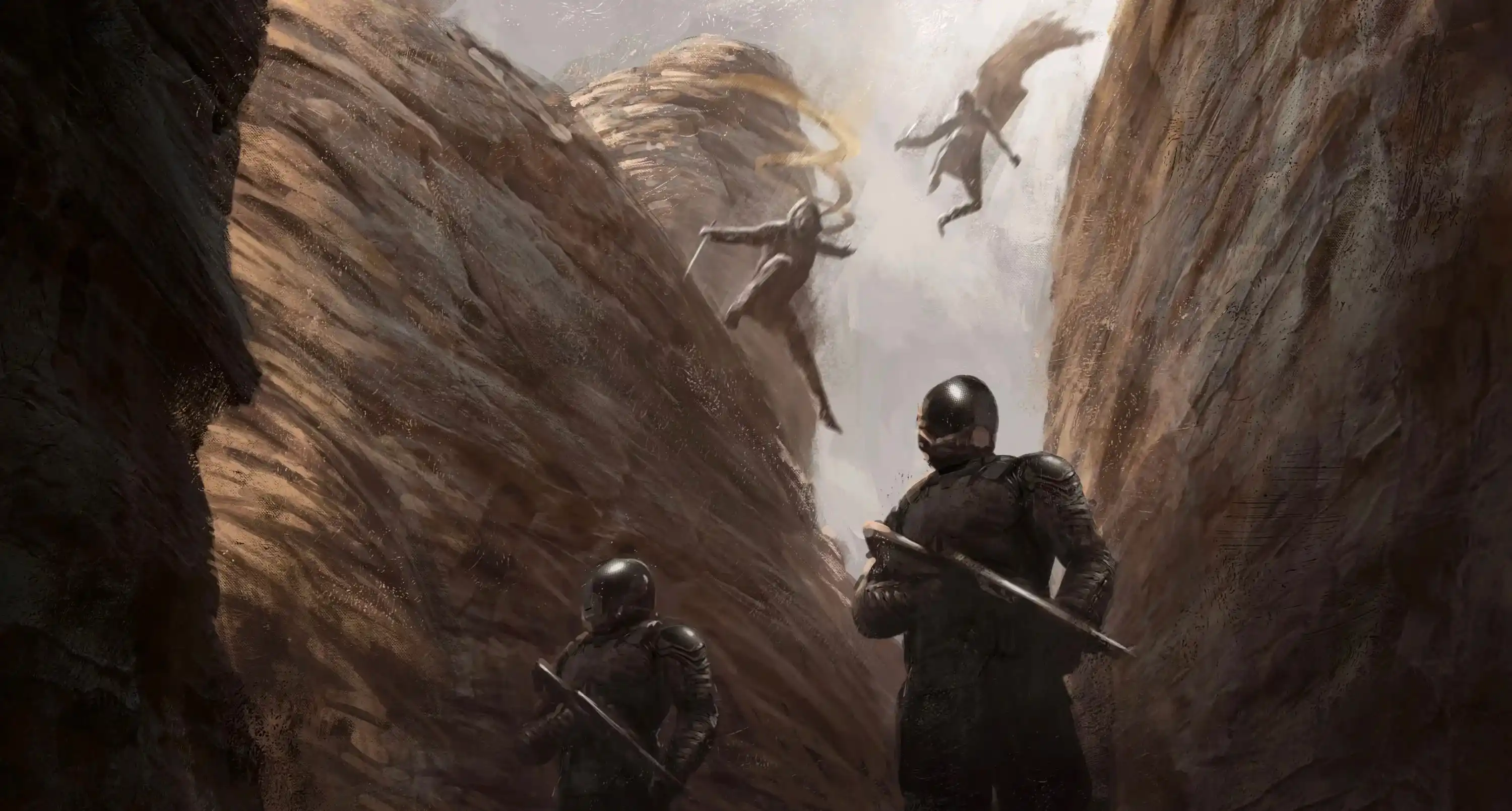
What the spice does to a body.
A noble who has taken it since childhood ages slowly and lives twice as long as anyone else. That shapes an entire aristocracy.
It sustains effort, clears the mind and holds off fatigue. A Mentat takes it to keep pace with his own calculations.
Under heavy exposure the eye loses its white and goes wholly blue. On Arrakis, that gaze says immediately where you come from.
Past a certain threshold, withdrawal kills. That is what gives whoever controls supply a power nothing else provides.
In very large doses it shows the possible paths of time. That is how Navigators plot their routes without calculating them.
The Bene Gesserit take a poison derived from the spice and transform it within themselves. Those who fail die, those who survive change in nature.
Who lives off the spice.
Without spice its Navigators no longer see the routes and travel between stars stops. It is the heaviest dependency in the known universe.
All production passes through its ledgers, and its shares are traded in the Landsraad. One lost cargo moves entire fortunes.
He grants Arrakis to the House of his choosing, and takes it back when it suits him. That gift has ruined more than one family.
Working Arrakis pays unreasonable sums and attracts every grudge going. Many have wanted it, few have recovered from it.
They divert what the ledgers will never see and pay the Guild to look away. The desert owes part of its reputation to them.
They take it in nearly everything they eat and stockpile reserves whose scale nobody suspects.
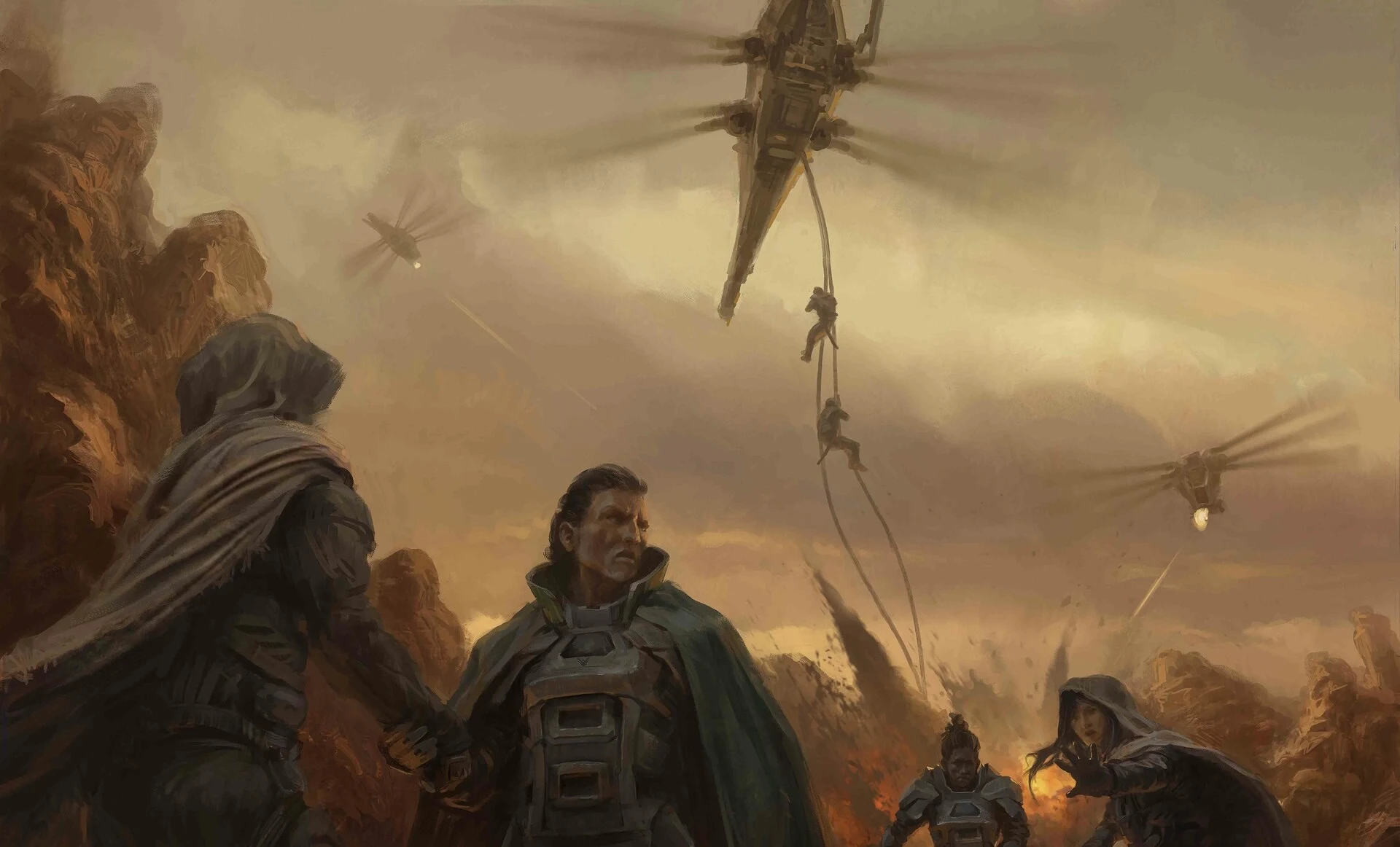
Harvesting it, at the risk of your life.
Spice surfaces in the deep desert, wherever the sand throws it up. Spotters fly over the area, an enormous harvester lands and draws it in for a few dozen minutes, no longer. Above it a carryall waits, ready to lift everything away at the first alarm.
Because the steady beat of the machines draws the worms, and a worm always comes. Harvesting therefore runs in short windows, under the threat of a beast hundreds of metres long and storms that can strip metal bare. Every cargo that reaches port was paid for in lost equipment, and often in lives.
Who controls the spice.
Nobody truly controls it, and that is what makes the balance so unstable. The Emperor grants the fief, CHOAM holds the trade, the Guild sets its shipping terms, the House in charge extracts and pays. Each can obstruct the others, none can do without the rest.
The one absolute threat would be destroying the source itself: whoever can annihilate a thing holds it more surely than whoever owns it. That logic runs through the whole of Dune, and it is also why an entire campaign can turn on a single diverted cargo.
The spice at your table.
A cargo to escort, a quota to meet, a ledger to falsify. Three sessions of play come out of a single order line.
A passage, a service, a silence: it all costs, and often in spice. It makes the economy of the Imperium concrete for your players.
A habituated character running short of melange is a plot in himself. No need for a rule, one scene does the work.
The countdown, the worm closing in, the carryall running late: tension builds without a single enemy being needed.
A neighbouring House, a smuggler, an overly curious official. Spice hands almost any antagonist a believable motive.
One blurred vision restarts a campaign, ten drain it of suspense. Save the effect for the moments that genuinely matter.
Playing the desert online.
A harvest scene plays out in images and countdowns: the sand vibrating, the harvester pumping, the shadow closing under the dune. Describing all of it in words alone, session after session, takes energy the game master would rather spend on the intrigue.
Tomeus brings the backdrop, the music, the sheets and the dice into one window. You prepare your scenes ahead of time, switch image and mood in one click, and your players join from home with their character in front of them, with nothing to install.
Go further with Dune.
How to start playing Dune?
Free starter kit, dice, character and House creation: the guide to getting started with Dune: Adventures in the Imperium, around a table or online.
The basic rules of Dune
The two d20s and the target number, the five skills, the five drives, the pools and the three scales of conflict: the rules of Dune explained.
The lore of Dune
The Imperium and its powers, the Guild, the Bene Gesserit, the Mentats, Arrakis and its spice: the lore of Dune explained, and how to use it at your table.
The archetypes of Dune
The archetypes of Dune explained: noble, Mentat, Bene Gesserit, swordmaster, spy and the rest, their place at court, and how to choose yours.
Go further with tabletop RPGs.
How to Play a Tabletop RPG: the Beginner's Guide
How a session unfolds, what the game master does, dice, character sheets and how to play a tabletop RPG online. A complete guide for beginners.
How to Find Players for a Tabletop RPG
Game shops, clubs, conventions, Discord, online listings: where to find players for your tabletop RPG and how to write an ad people answer.
How to Prepare a Tabletop RPG Campaign
Setting, central stake, factions, NPCs and per-session prep: the method to build a tabletop RPG campaign without writing everything in advance.
How to Create a Tabletop RPG Character
Concept, class, ability scores, skills, backstory and bonds: the full method to create a tabletop RPG character who will carry a whole campaign.
Frequently asked questions.
What exactly is the spice?
A natural substance produced only on Arrakis, tied to the life cycle of the sandworms. It lengthens life, sharpens the senses and, in very large doses, opens glimpses of what is coming. It also creates a lifelong dependency. Nobody has ever made it elsewhere, and that is precisely what gives one desert planet the power to bend an empire.
How are the spice and the sandworms connected?
Melange comes from the worms' life cycle, whose young forms live beneath the sand and cause the spice to blow to the surface. Without knowing it, the worms therefore defend the most precious resource in the universe: you cannot harvest without drawing them, and you cannot remove them without drying up the source.
How do you make the spice drive a campaign?
Give your House a direct interest in a cargo, a quota or a route, then let three factions want the same thing. Everything follows from there: escort, sabotage, negotiation with smugglers, pressure from CHOAM, and an imperial official asking questions at the worst possible moment.