
The lore of Dune.
The universe of Dune is not a future of starships and robots, but a feudal empire ten thousand years old, where people fight with blades and thinking machines have been banned so long that nobody remembers why they were frightening.
Here is that setting gathered in one place, in the order it comes up at the table. The Imperium and its balance, the powers that share it, the figures you meet at court, Arrakis and its spice, and how war is waged without ever being declared.
What is the Imperium?
The Imperium binds thousands of worlds under one emperor, and yet none of those worlds truly belongs to him. Each planet is held by a noble House that works it, defends it and passes it to its heirs. Above them, three forces watch each other: the Emperor with his elite troops, the assembly of the Houses, and the Guild holding the monopoly on travel between stars.
The balance holds because nobody can win alone. The Emperor has the army but not the ships, the Houses have the wealth but fear each other, the Guild has the transport but depends on a substance produced on a single planet. Thinking machines were banned after an ancient war, so trained humans stand in for computers, and that changes everything.
The powers of the Imperium.
He rules from his throne with fanatical soldiers raised on a prison world. Mostly he governs by setting the Houses against one another.
It gathers the great Houses and counterweighs the throne. No imperial decision survives long once it chooses to stand against it as one.
Everything traded passes through it, and its shares are split between the Emperor and the Houses. Nearly every intrigue ends up circling them.
It alone knows how to fold space, and so sets the price of every journey. It never takes sides, as long as the spice keeps arriving.
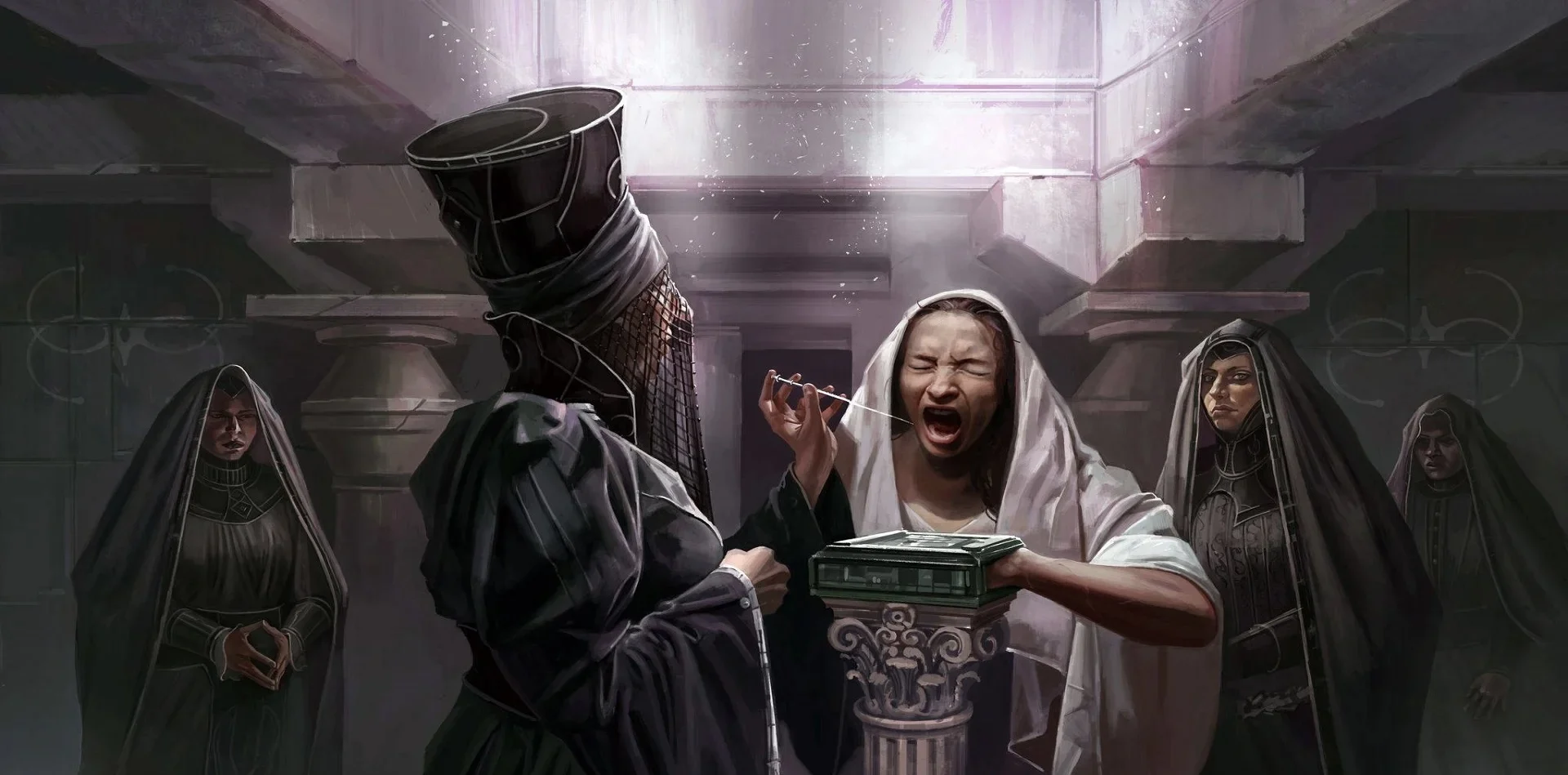
Advisers, wives, teachers, they are everywhere and appear nowhere. Their plan is measured in generations, not in years.
One builds machines at the edge of what is banned, the other shapes living beings to order. You deal with them, you do not invite them.
The figures of a court.
Trained to calculate and project the way a machine would, he advises his duke and is never wrong often enough to be dispensed with.
His school makes him theoretically incorruptible, which puts him closer to the duke than anyone else. Theoretically.
He trains the guards, guards the heirs and fights slowly, because shields have made speed useless.
He handles the poisons, the spies and whatever the House cannot do in daylight. Every court keeps one and pretends otherwise.
Sealed inside a tank of gas, he sees the safe routes before taking them. Very little of him is still human, and he knows it.
They survive where nobody lasts a day, count their water by the drop, and fight better than any imperial soldier.
Arrakis, and its spice.
Arrakis is a planet of sand where water is counted in drops and the night kills as readily as the day. It would matter to nobody but for a substance found nowhere else: the spice, which lengthens life, sharpens the mind and lets Navigators see the routes through the void. The whole politics of the Imperium fits in one line, whoever controls the spice controls the universe.
Harvesting it costs dearly, in machines and in people. Sandworms hundreds of metres long rise at the slightest regular beat and take whatever is left standing. Deep in the desert live the Fremen, whom successive governors have made a habit of underestimating, and who know things about this planet nobody else bothered to learn.
Waging war without declaring it.
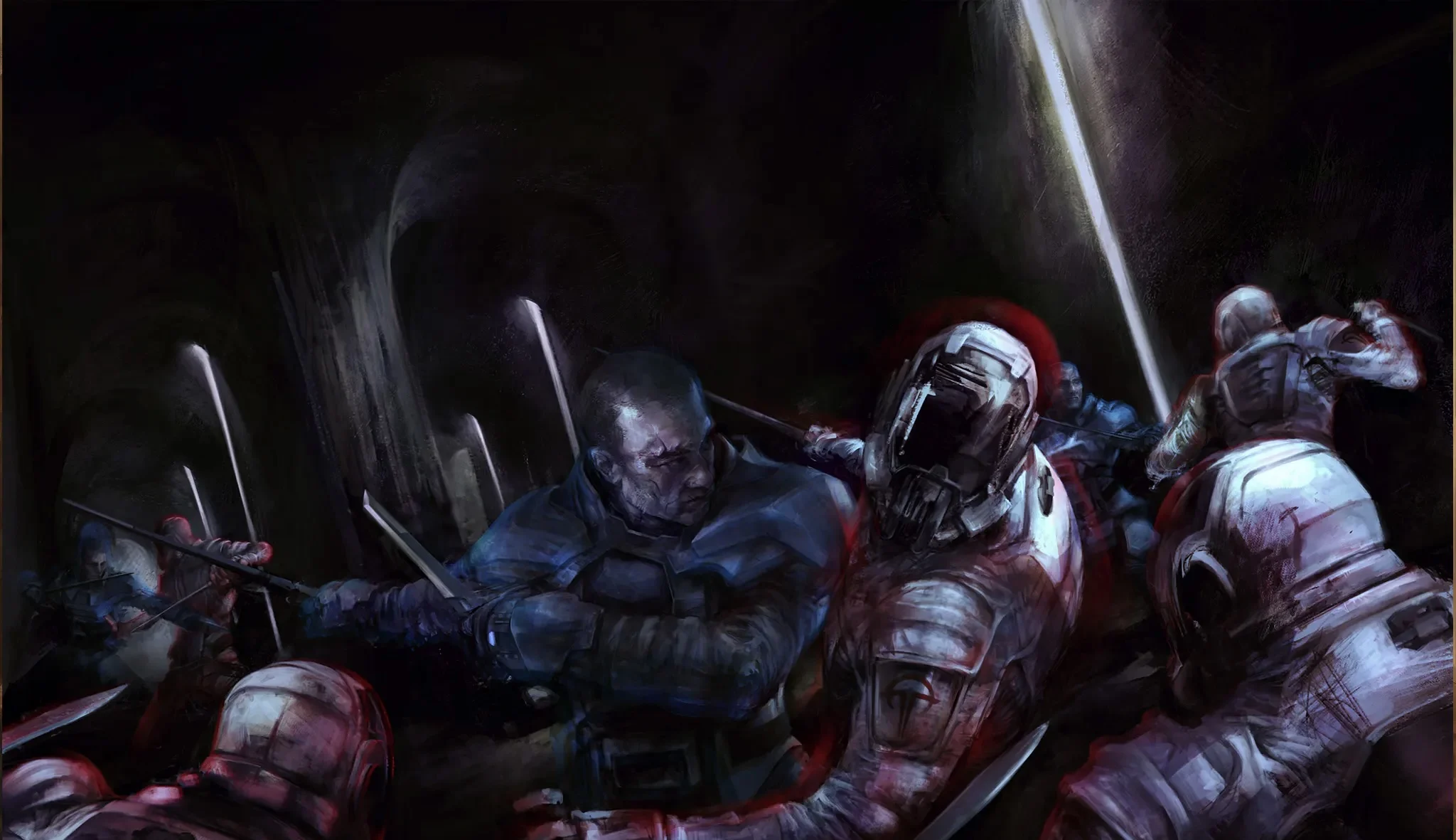
Personal shields stop anything moving fast, which sent armies back to blades and close quarters. Atomics still exist, every House keeps a stockpile, but using them against people would mean destruction by all the others combined. What remains is poison, the spy, the rumour and the trade contract.
A House that means to destroy another formally declares its vendetta and opens a war of assassins, bound by rules everyone respects because everyone benefits from them. That sets the tone of the setting: drawn knives are the exception, and the usual weapon is a sentence spoken at the right moment in front of the right witnesses.
Using this lore at your table.
One holding, two rivals and a debt are enough to launch a campaign. Your players will remember their House long before the map of the empire.
Before, during or long after the novels: the game works anywhere. State the date at session one, it saves a great many arguments.
A contract, a diverted cargo, a debt paid in melange. It is the thread tying any intrigue to the rest of the universe.
A neighbouring House, an ambitious cousin, a stolen contract. Almost everything played in Dune starts from an old grudge.
Invent a planet, a minor House, a forgotten school. Thousands of worlds exist and canon describes only a handful of them.
Nobody at your table needs to settle novels against films. Take what serves your story and leave the rest.
Bringing the Imperium to life online.
A setting like Dune lives on images: an audience chamber, a sandstorm, a banquet where nobody eats first. Describing all of it in words, session after session, takes energy the game master would rather spend on the intrigue.
Tomeus brings the backdrop, the music, the sheets and the dice into one window. You prepare your scenes ahead of time, switch image and mood in one click, and your players join from home with their character in front of them, with nothing to install.
Go further with Dune.
How to start playing Dune?
Free starter kit, dice, character and House creation: the guide to getting started with Dune: Adventures in the Imperium, around a table or online.
The basic rules of Dune
The two d20s and the target number, the five skills, the five drives, the pools and the three scales of conflict: the rules of Dune explained.
The archetypes of Dune
The archetypes of Dune explained: noble, Mentat, Bene Gesserit, swordmaster, spy and the rest, their place at court, and how to choose yours.
The spice of Dune
Melange explained: its effects, longevity, prescience and dependency, who lives off it, harvesting against the worms, and how to make it drive a campaign.
Go further with tabletop RPGs.
How to Play a Tabletop RPG: the Beginner's Guide
How a session unfolds, what the game master does, dice, character sheets and how to play a tabletop RPG online. A complete guide for beginners.
How to Find Players for a Tabletop RPG
Game shops, clubs, conventions, Discord, online listings: where to find players for your tabletop RPG and how to write an ad people answer.
How to Prepare a Tabletop RPG Campaign
Setting, central stake, factions, NPCs and per-session prep: the method to build a tabletop RPG campaign without writing everything in advance.
How to Create a Tabletop RPG Character
Concept, class, ability scores, skills, backstory and bonds: the full method to create a tabletop RPG character who will carry a whole campaign.
Frequently asked questions.
Do you need to know the lore to play Dune?
No. Three sentences carry a first session: a feudal empire, a desert planet producing the spice, noble Houses fighting without declaring war. The rest is learned by playing, audience after betrayal, exactly the way the characters find it out themselves.
When in the Dune timeline is the game set?
By default just before the events of the first novel, while the great Houses still contest Arrakis and nothing is settled. The book also explains how to place a campaign centuries earlier or later. A minor House far from the spotlight leaves you the most freedom of all.
Why does the spice matter so much?
Because it lengthens life, sharpens the mind and makes interstellar travel possible: without it, the Imperium comes apart within years. Since it is found only on Arrakis and cannot be manufactured, whoever holds that planet holds everyone else, the Emperor included.