
How to start playing Pathfinder?
Pathfinder is the great heroic fantasy game standing opposite Dungeons & Dragons: the same family of rules, but a more tactical, more precise system, and characters you shape one choice at a time. Its reputation as a dense game puts off many tables before the first session.
That reputation is half earned and half wrong: the complete rules are free and legal online, and a first session fits into one evening. Here is what the game does, what you need to gather, how to build a first character and how to run your first session, around a table or online.
What is Pathfinder?
Pathfinder is a tabletop role-playing game published by Paizo, born in 2009 out of a Dungeons & Dragons variant and since grown into its own game. Its second edition, released in 2019 and overhauled in 2023, is set in a heroic fantasy world named Golarion. A game master describes the places and arbitrates, the other players each play one adventurer.
Two mechanics give the game its signature. Every character gets three actions per turn, spent freely: three attacks, a move and two spells, whatever they want. And every d20 roll produces four possible outcomes depending on how far it lands from the difficulty class, from critical success to critical failure. Chance stops being binary and becomes a matter of degree.
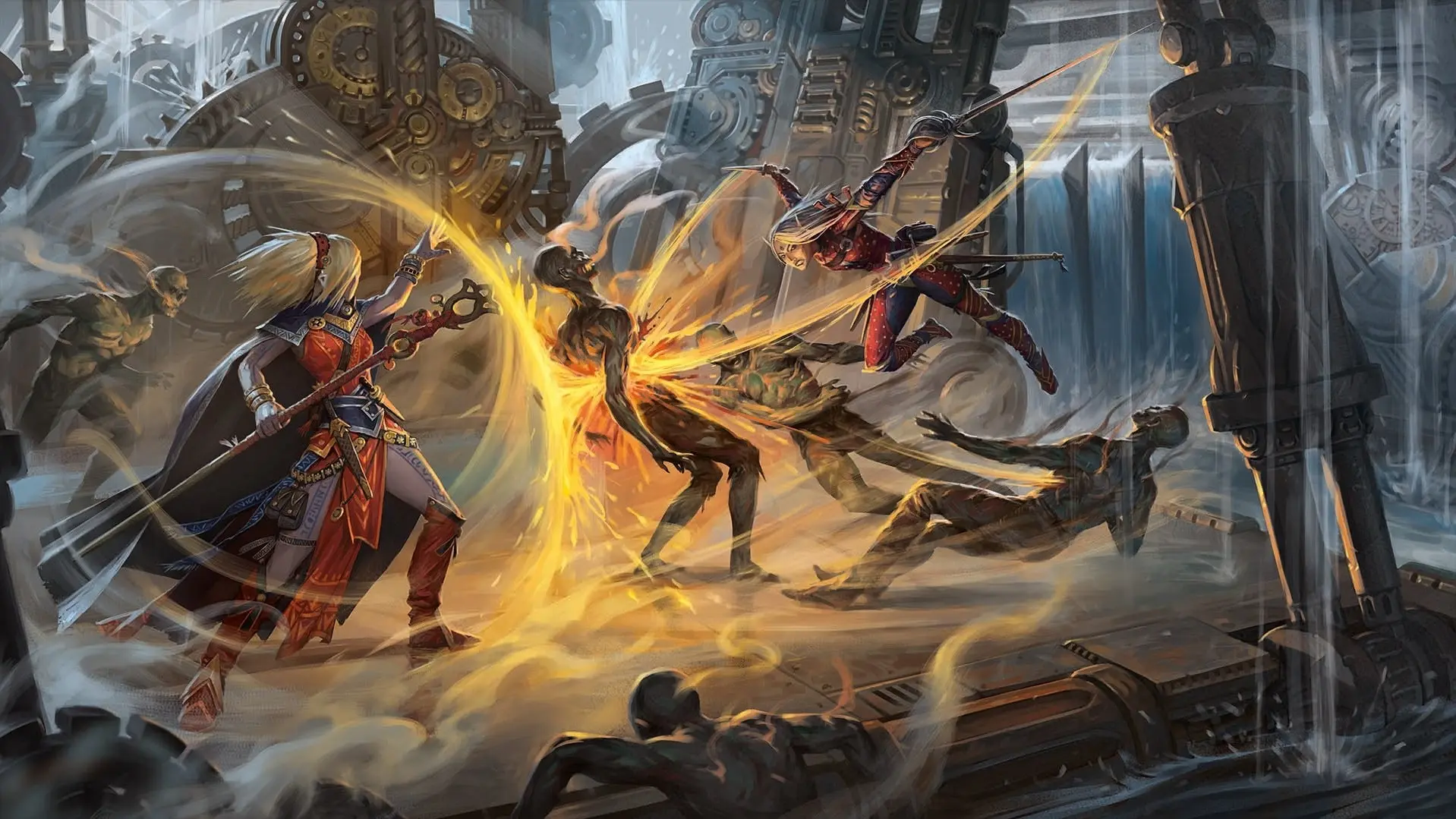
Starting Pathfinder, step by step.
The complete rules are published free and legally online. No purchase is needed to run a whole campaign.
Four players is the balance every official encounter is built for. With three, the encounter budget shifts and fights get rough.
They run the creatures, the scenery and above all the degrees of success. Pathfinder asks for slightly more prep than average, but everything is already written.
Ancestry gives your origin and a few feats, class decides what your three actions do. Fighter or rogue remain the simplest entries.
Ancestry, background, class, then feats: allow an hour the first time. An online builder saves you from the usual arithmetic slips.
The beginner box holds a dungeon, ready made characters and trimmed down rules. The best entry point in the game, for the game master too.
What you need to get started.
Every rule is available for free, under an open licence. The books buy you comfort of reading, not access to the rules.
The d20 decides everything, the others handle damage and healing. One set per player saves passing them round every turn.
The official sheet runs to four pages, which is a surprise at first. An online version adds up the bonuses and tracks levelling.
The beginner box or a short adventure covers three sessions. The official campaigns are twenty times longer, they can wait.
A Pathfinder fight easily runs forty minutes with five people. Allow four hours for exploration and a battle in the same session.
Every character piles up feats, conditions and items that change their actions. A three line cheat sheet per player speeds up every turn.
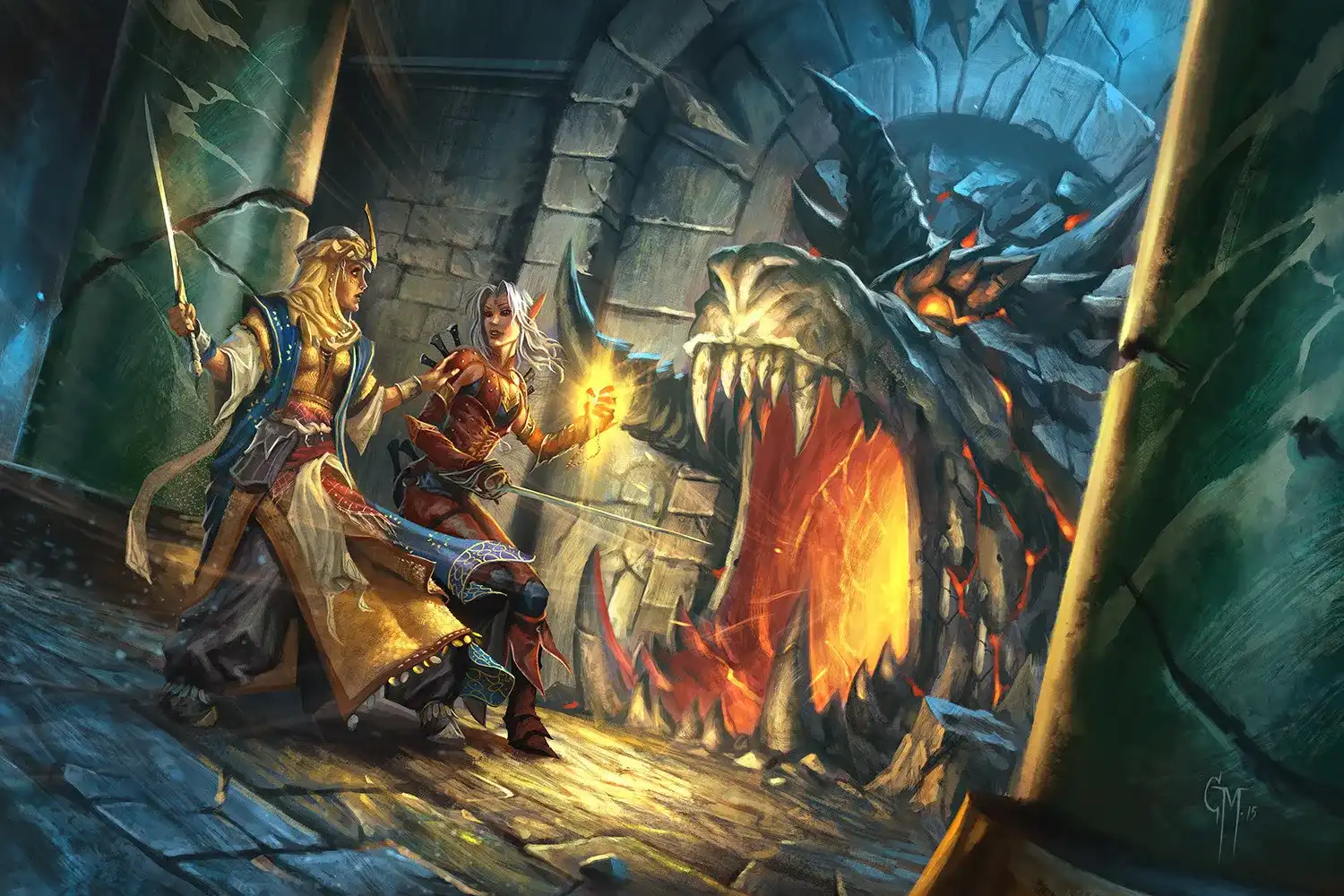
Building your first character.
A Pathfinder character rests on three pillars, picked in that order: an ancestry, human, dwarf, elf or goblin, which sets where you come from, a background, which tells what you did before the adventure, and a class, which decides what you can do. The six ability scores are then assigned through a series of choices, with no dice rolled.
Then comes the part the game is known for: feats. At almost every level you gain one, drawn from your ancestry, your class or your skills. That is where two fighters become two different characters. Count an hour for a first sheet, or start from a pre-generated character in the beginner box and keep creation for the next session.
Your first session.
The Pathfinder beginner box exists exactly for this: a short adventure, ready-made characters, dice and a rules set trimmed to the essentials. It spares you the six hundred pages of the core book and gets you playing in one evening.
At the table, hold on to the three actions per turn and let the rest follow. A position on a grid, a distance in squares, and the players quickly grasp what their actions cost. When a rule is unclear, the game master calls it, notes the question and checks after the session: the game is thoroughly documented, the answer always exists somewhere.
The mistakes beginners make.
The core book runs past six hundred pages, nobody reads it in one go. Read your class, the three action economy and the conditions, that is enough.
Three actions a turn, and nothing says they must all be attacks. Moving, aiding an ally or raising a shield often beats a third swing.
The second attack in a turn takes minus five, the third minus ten. With an agile weapon the penalty drops to minus four and minus eight.
Beating the DC by ten is a critical success, missing it by ten a critical failure. This is the heart of the system, not an optional rule.
A level 1 wizard already juggles preparation, slots and cantrips. A class without spells lets you learn the game without spending the evening on it.
Characters are built to complement each other: healing, accuracy, skills, control. Built separately, one of those four pieces is always missing.
Playing Pathfinder online.
Pathfinder plays best with a battle map in sight: the three actions, the moves and the distances all matter, and everyone gains from seeing the same scene.
Tomeus gives you that shared scene with no setup: you create a game, import a backdrop image, pick a track and send the link. Your players join in one click, with the sheets, the chat and the dice roller in the same window.
Go further with Pathfinder.
The Basic Rules of Pathfinder
The d20 and the four degrees of success, the six ability scores, proficiency, the three actions, hit points and the dying condition: the rules of Pathfinder.
The Lore of Pathfinder
Golarion and the Inner Sea, the Age of Lost Omens, the ancestries, the gods and the great threats: the lore of Pathfinder explained, and how to use it at your table.
The Classes of Pathfinder
The sixteen classes of the two core books, the subclasses, the class feats and multiclassing through archetypes: the classes of Pathfinder explained.
The Bestiary of Pathfinder
Reading a stat block, the creature types, what a monster level means, the experience budget of an encounter and the elite and weak adjustments.
Go further with tabletop RPGs.
How to Find Players for a Tabletop RPG
Game shops, clubs, conventions, Discord, online listings: where to find players for your tabletop RPG and how to write an ad people answer.
How to Prepare a Tabletop RPG Campaign
Setting, central stake, factions, NPCs and per-session prep: the method to build a tabletop RPG campaign without writing everything in advance.
The Best Tabletop RPGs for Beginners
Dungeons & Dragons, Call of Cthulhu, Alien, Monster of the Week: six easy tabletop RPGs for a first session, and how to pick the right one.
How to Create a Tabletop RPG Character
Concept, class, ability scores, skills, backstory and bonds: the full method to create a tabletop RPG character who will carry a whole campaign.
Frequently asked questions.
Do you need to buy books to start playing Pathfinder?
No. The publisher puts the entire rules set online for free and legally, classes, spells and feats included. You can run a whole campaign without buying anything. The beginner box is still the best first purchase, for its adventure and its ready-made characters.
What is the difference between Pathfinder and Dungeons & Dragons?
Both games share the d20 and the same family of rules. Pathfinder asks for a little more learning and makes each turn more tactical, with its three actions and four degrees of success. Dungeons & Dragons is quicker to pick up, Pathfinder offers deeper customisation and a more complete free rules reference.
Which class should a first character take?
Fighter to learn the three actions and combat with nothing else to juggle, champion to absorb hits and protect the party, barbarian to hit hard and simply. Leave the wizard, the bard and the alchemist for later: their spell and resource lists take an evening of reading.