
How to play a tabletop RPG?
A tabletop role-playing game gathers a few players around a story. Each of them plays a character, a game master describes the world and voices everyone else, and the dice settle what skill alone cannot carry.
No experience is needed to start. This guide covers how a session unfolds, what you need to gather, and how to play a tabletop RPG online when your players do not live in the same city.
What is a tabletop RPG?
A role-playing game session, often shortened to RPG, is a story told together. One player takes the game master seat: they describe the places, voice the characters you meet and arbitrate the rules. The others each play one character, summed up on a character sheet listing their abilities and gear.
There is no board, no winner and no ending written in advance. The game master sets a situation, the players say what their characters do, and a dice roll settles the actions whose outcome is uncertain. The session moves forward that way, scene after scene, for three to four hours.
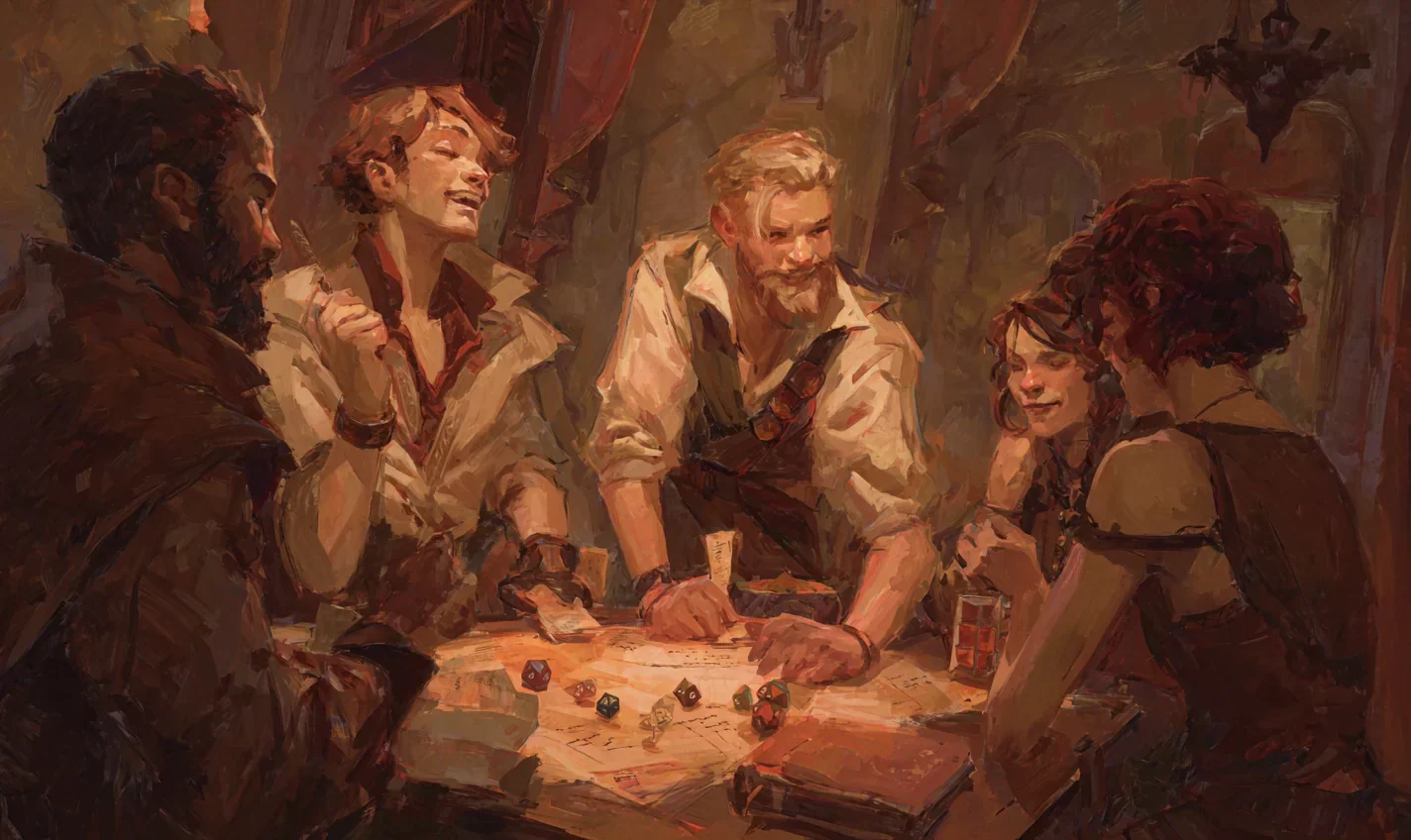
Your first session, step by step.
A simple game and a setting the table already knows. Fantasy, horror investigation or science fiction: what matters is that everyone wants to spend an evening there.
Three players are enough, five is comfortable. Beyond that everyone waits their turn and scenes drag on.
One person describes the world and plays everything that is not a player character. They do not need to know everything, only to have read the scenario.
Set aside an hour, all together, around the same table. Characters created on the same evening naturally have reasons to travel together.
Start in the middle of the action, not at the inn. A door kicked in, a body found, and the session starts on its own.
Roll only when failure would be interesting. The rest of the time, what the player describes is enough to move the scene forward.
What you need to get started.
A game, first. Dungeons and Dragons for heroic fantasy, Call of Cthulhu for horror investigation, or any starter set built for beginners. The core book is enough, and the game master is the only one who has to read it in full.
Then dice, one character sheet per player, something to write with, and a three-hour slot. That is all. The rest, backdrops, artwork, ambient music, is never mandatory, but it changes a great deal of what your players feel around the table.
Playing a tabletop RPG online.
Your players rarely all live in the same city, and free evenings seldom line up. Playing online solves that: everyone joins the session from home, with voice, video and a shared space that stands in for the table.
That space has a name, the virtual tabletop, or VTT. It holds the backdrop of the current scene, the character sheets, a dice roller everyone can see and ambient music. Most of these tools ask for hours of setup before the first scene.
Playing online with Tomeus.
Tomeus is a virtual tabletop built for the opposite: you create a game, import a backdrop image, pick a track and send the link. Your players join in one click, with nothing to install and nothing to configure.
You get character sheets, audio and video, chat, dice and a music catalogue, all in a single window. Enough to run your first online RPG session the very same evening.
Go further with tabletop RPGs.
How to Find Players for a Tabletop RPG
Game shops, clubs, conventions, Discord, online listings: where to find players for your tabletop RPG and how to write an ad people answer.
How to Prepare a Tabletop RPG Campaign
Setting, central stake, factions, NPCs and per-session prep: the method to build a tabletop RPG campaign without writing everything in advance.
The Best Tabletop RPGs for Beginners
Dungeons & Dragons, Call of Cthulhu, Alien, Monster of the Week: six easy tabletop RPGs for a first session, and how to pick the right one.
How to Create a Tabletop RPG Character
Concept, class, ability scores, skills, backstory and bonds: the full method to create a tabletop RPG character who will carry a whole campaign.
Discover Dungeons & Dragons.
How to Start Playing Dungeons & Dragons
Free basic rules, dice, character creation and a first session: the complete guide to start playing Dungeons & Dragons, around a table or online.
The Basic Rules of Dungeons & Dragons
The d20 and the difficulty class, the six ability scores, the rolls, the combat turn, hit points and resting: the basic rules of D&D explained simply.
The Lore of Dungeons & Dragons
The multiverse and its planes, the great worlds, the peoples, the pantheons and the dragons: D&D lore explained, and how to use it at your table.
The Classes of Dungeons & Dragons
The twelve D&D classes explained: barbarian, fighter, rogue, cleric, wizard and the rest, their subclasses, and how to pick yours as a beginner.
Frequently asked questions.
How long does a tabletop RPG session last?
Count three hours for a first session, character creation included. Many groups then play three to four hour sessions every other week, and string them into episodes of the same campaign for months.
Which RPG should beginners start with?
A short game with few rules. The starter sets of Dungeons and Dragons or Call of Cthulhu include a scenario, ready-made characters and a rules summary: enough to run a session without reading three hundred pages of manual.
How many players do you need?
One game master and three to five players is the usual balance. Two works as well, with a single player and more intimate scenes. Past six, everyone waits too long for their turn to speak and the pace collapses.