
The basic rules of Dune.
Dune rests on a single mechanic, repeated session after session. Two twenty-sided dice, a skill, a drive, a number to stay under: from a blade duel to a manoeuvre at court, everything is settled with the same move.
Here are those rules gathered in one place, in the order they actually come up at the table. The test and its target number, the five skills, the five drives, the two pools in play, the three scales of conflict and what happens when you lose.
The rule that governs everything.
Every action with an uncertain outcome is settled the same way. You add the skill you are using to the drive pushing you to act: that total is your target number. You then roll two twenty-sided dice, and each die equal to or under that number generates one success.
The game master states how many successes the action demands, usually one for an everyday task, two or three when the situation pushes back. A fitting focus makes some dice twice as effective, and a 20 brings a complication whether the action succeeds or not. One target number, two dice, a number of successes to reach: the whole system follows from there.

The five skills.
It covers the duel, the skirmish and the handling of an army. In the Imperium, knowing how to fight matters even to those who never draw.
Negotiating, lying, scheming, reading a room. It is the most used skill in a political campaign, and nearly every campaign is one.
It measures composure, self control and resistance to pressure, from slow poison to an interrogation that drags on.
Running, hiding, piloting, clearing an obstacle. Useful for getting into a place, more useful still for leaving it alive.
Observing, investigating, recalling, calculating. It is the Mentat's skill, and that of anyone who works it out before the others.
The five drives.
It carries obedience, service and loyalty. It is the drive of soldiers, of retainers and of heirs who accept the weight handed to them.
Religion, tradition, absolute trust placed in a person. It gives the strength to act without proof, sometimes against all reason.
It pushes you to set things right, to shield the weak and to punish wrongs. Rarely the safest path inside a feudal empire.
Ambition, influence, the position you intend to hold. Plenty of nobles never act for anything else at all.
Curiosity, secrets, whatever hides behind appearances. It drives investigations forward and gets the careless killed.
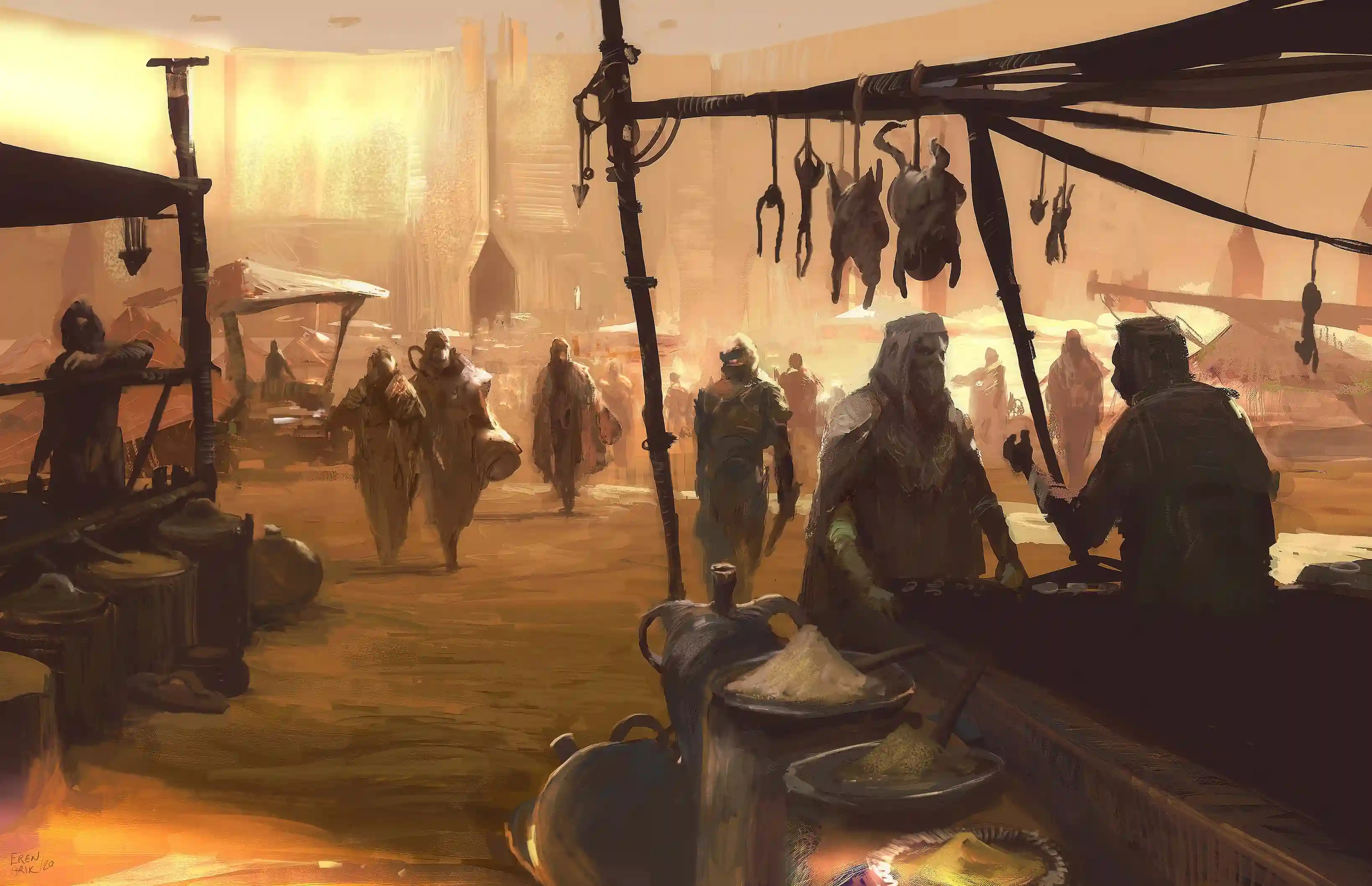
The three scales of conflict.
A confrontation always plays out the same way, whatever its size. A duel pits two blades in a room, an intrigue pits influences across a court, warfare pits armies over a whole planet. The rules do not change: only the weight of the stakes and the nature of the positions held shift.
Everyone acts on their turn, moves from one zone to another, creates assets and tries to deny them to the other side. A conversation at a banquet is therefore cut up like a battle, with its advances, its retreats and its openings. That is what lets a Dune campaign treat a plot with the same tension as an assault.
Wounds and defeat.
Dune has no hit points. A blow taken imposes a trait, which concretely gets in the way of whatever you try next: a broken leg, a dented reputation, a shaken conviction depending on the kind of conflict. Stack those traits up and you end up defeated, which does not always mean dead.
Drives take the same damage. A statement put to the test can break, and the character then changes what they believed. That is the real engine of the game: a noble walks out of an intrigue alive but with a loyalty in pieces, and that crack marks a campaign far more than any physical wound.
What to remember at the table.
Faced with any situation, find the skill you are using and the drive pushing you. Everything else is scenery.
Always check whether one of yours applies before the dice leave your hand. It is the rule most often forgotten in a first session.
They feed a shared pool the whole group can spend. It drains between scenes, so there is no point in hoarding it.
It grows whenever you take a shortcut, and pays for complications later. A die bought now is always paid for afterwards.
A duel, a plot and a battle resolve identically. No need to learn three systems, there is only one to know.
A well written statement earns dice and sets off whole scenes. Read yours again before each session.
Applying the rules online.
Tracking everyone's target numbers, the two pools rising and falling, the traits stacking up and the zones of a conflict on the corner of a table ends up taking more attention than the scene itself. The game master spends the evening recounting instead of describing.
Tomeus brings the sheets, the dice roller, the backdrop and the music into one window. You create the game, send the link, and your players turn up with their character in front of them, with nothing to install and nothing written on a sheet of paper that gets lost.
Go further with Dune.
How to start playing Dune?
Free starter kit, dice, character and House creation: the guide to getting started with Dune: Adventures in the Imperium, around a table or online.
The lore of Dune
The Imperium and its powers, the Guild, the Bene Gesserit, the Mentats, Arrakis and its spice: the lore of Dune explained, and how to use it at your table.
The archetypes of Dune
The archetypes of Dune explained: noble, Mentat, Bene Gesserit, swordmaster, spy and the rest, their place at court, and how to choose yours.
The spice of Dune
Melange explained: its effects, longevity, prescience and dependency, who lives off it, harvesting against the worms, and how to make it drive a campaign.
Go further with tabletop RPGs.
How to Play a Tabletop RPG: the Beginner's Guide
How a session unfolds, what the game master does, dice, character sheets and how to play a tabletop RPG online. A complete guide for beginners.
How to Prepare a Tabletop RPG Campaign
Setting, central stake, factions, NPCs and per-session prep: the method to build a tabletop RPG campaign without writing everything in advance.
The Best Tabletop RPGs for Beginners
Dungeons & Dragons, Call of Cthulhu, Alien, Monster of the Week: six easy tabletop RPGs for a first session, and how to pick the right one.
How to Create a Tabletop RPG Character
Concept, class, ability scores, skills, backstory and bonds: the full method to create a tabletop RPG character who will carry a whole campaign.
Frequently asked questions.
Where can you find the Dune rules for free?
Modiphius offers a starter kit as a free download: it holds a trimmed version of the system, ready-made characters and a complete adventure. Enough to run a session or two. The core book becomes necessary after that, to freely build a House and characters and to reach every talent.
What are the two pools for?
The group's pool fills with extra successes and buys concrete effects: an extra die, a piece of information, an advantage that lasts. The game master's pool grows whenever the players take shortcuts, and pays for complications later. Together they give the game its rhythm of ebb and flow.
Is the system complicated for beginners?
No. A single mechanic covers the whole game, and a table can spend a full evening knowing nothing but the basic test. Pools, focuses and conflict scales fold in naturally across sessions, without ever changing the move you started with.