
The lore of Pathfinder.
Pathfinder is set by default on Golarion, a world of heroic fantasy where empires follow one another, where the gods sometimes answer, and where a prophecy centuries in the making stopped dead in the year 4606. Nobody on that planet has known what tomorrow holds since.
Here is enough to find your bearings in the lore of Pathfinder without reading the whole library: the world and its era, the regions most campaigns take place in, the playable peoples, the gods, the great threats, and above all how to use any of it at your table.
Golarion, a world seen from the Inner Sea.
Golarion is the third planet of its solar system, but almost all of the game happens in a single region: the Inner Sea, between the continent of Avistan to the north and Garund to the south. You will find a decadent empire, a young democracy, an infernal theocracy, the ruins of vanished civilisations, and one neutral city in the middle of it all, Absalom.
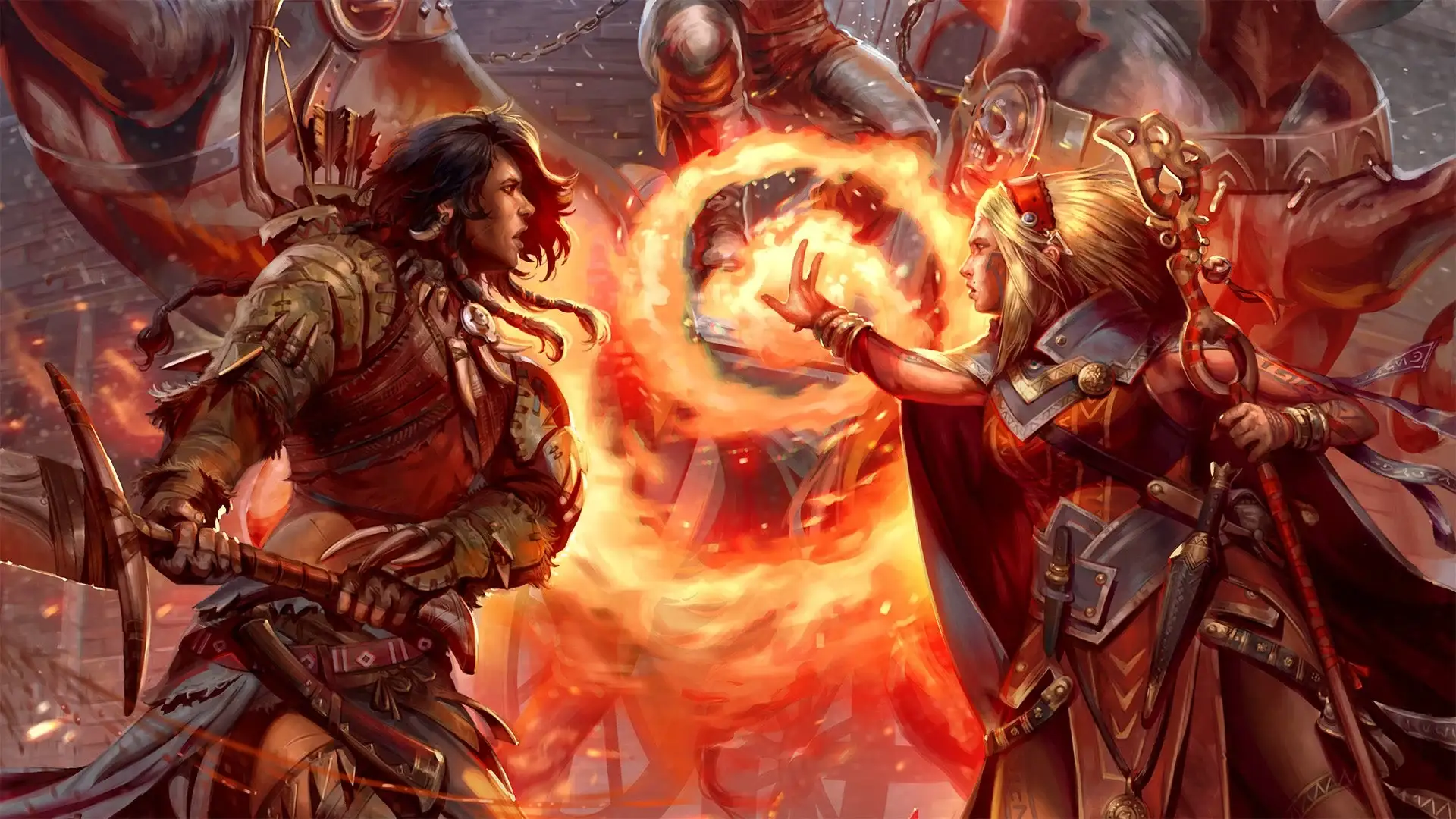
The overall tone is heroic fantasy, but every region has its own genre: Cheliax plays political drama and devilish bargains, Ustalav gothic horror, Numeria science fantasy, Varisia ancient dungeons. So you are not only picking a starting point, you are picking the style of your campaign.
The regions of the Inner Sea.
A vast, neutral city where everyone passes through and every faction keeps an office. The default starting point for the Pathfinder Society.
Thassilonian ruins, dungeons and a wild frontier: the most classic setting. Most introductory campaigns take place there.
An empire that signed a pact with Asmodeus and enforces it through devils. You play resistance, intrigue or compromise there.
Misty counties, manors, vampires and suspicious villagers. The region to pick for a horror campaign without changing games.
A starship crashed there millennia ago, leaving robots and energy weapons. Fantasy and science fiction officially share the ground.
Vast forests, ancient cities and kingdoms the imperial maps ignore. The region was entirely rewritten to move past colonial clichés.
The peoples and the ancestries.
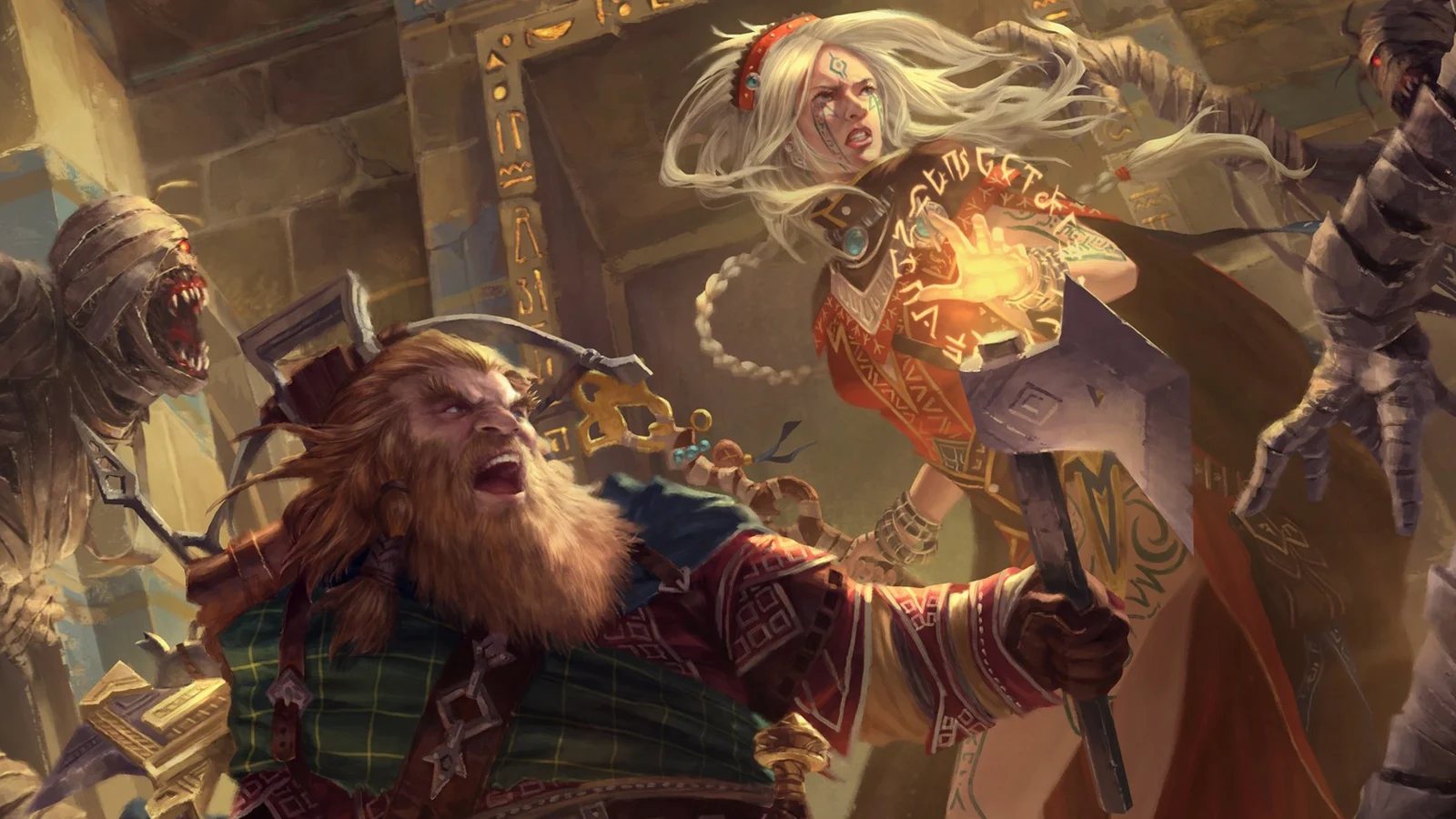
Humans hold most of the Inner Sea, but Pathfinder puts every other ancestry on an equal footing: dwarves, elves, gnomes, halflings, orcs and goblins share the same tavern without anyone raising an eyebrow. The playable goblin, an arsonist with a singing habit, has even become one of the game's trademarks.
The catalogue has grown with the supplements: leshies, plant creatures animated by a spirit, kobolds, tengu, lizardfolk, androids out of Numeria. Since the 2023 remaster, half-elf and half-orc are no longer ancestries of their own but heritages grafted onto another one. Golarion owns that mix: an origin tells a story there, it does not set a morality.
The Age of Lost Omens.
In 4606, the god Aroden was due to return to Golarion, exactly as his own prophecy had announced for centuries. He died instead, with nobody knowing how, and every prophecy in the world stopped working overnight. Storms tore across the Inner Sea, Cheliax fell into civil war before handing itself to Asmodeus, and a wound opened in the north.
That is the era Pathfinder is played in, a little over a century later, around the year 4720. The premise is a gift for a game master: since the future is no longer written, no chosen one is announced, no ending is guaranteed, and what the characters do actually counts. The world also moves forward with the publications, one official campaign after another.
The threats hanging over the world.
Seven lords, seven sins, and rune magic buried under the ruins. Their awakening drives the very first official campaign.
The most famous lich on Golarion, freed from his prison and settled in the north. His presence redraws the political map of the continent.
The Worldwound was sealed, but the demons did not simply vanish. The ideal backdrop for a high level campaign.
Three layers of caverns beneath the surface, with their own peoples and their own wars. A dungeon can descend through twenty levels there.
They hold land, negotiate and remember insults for centuries. A neighbouring dragon is a plot, not just a fight.
Lamashtu, Norgorber and Urgathoa recruit in the cities, quietly and effectively. An urban cult supplies a whole campaign without leaving the walls.
The gods and their faithful.
Golarion's pantheon reads like a directory, and every character finds something in it. Pharasma judges souls and watches over birth as much as death, Sarenrae offers the sun, healing and a second chance, Iomedae honour and duty, Desna dreams, stars and the open road, Abadar cities, contracts and well earned wealth. Facing them, Asmodeus sells tyranny in the shape of contracts, Zon-Kuthon turns pain into doctrine, and Rovagug, god of pure destruction, stays locked in a prison at the heart of the world.
One Golarion quirk: you can become a god there. The Starstone cathedral in Absalom tests those who cross it, and three living deities came out of it, among them Cayden Cailean, who claims he attempted the test drunk. The reverse holds too: a god can die. Aroden proved it, and the War of Immortals recently cost Gorum, god of battle, his life. The pantheon is not a fixed backdrop, it moves.
Using Golarion at your table.
Golarion is enormous and nobody knows all of it, not even the authors. One region, one city and three factions will carry a campaign.
An official adventure path gives you whole volumes, maps and level appropriate creatures. Far less work than a world built from scratch.
The pantheon is central: every character swears, prays or blasphemes in someone's name. A chosen deity supplies morals, enemies and spells.
Dwarf, elf, goblin or human: ancestry says where you come from, not how you behave. Recent books insist on this point heavily.
Since prophecy failed, nobody knows what comes next. A direct invitation to let the players decide what happens.
Twenty years of publications inevitably contradict themselves somewhere. Pick the version that serves your table and write that choice down.
Bringing Golarion to life online.
Golarion is a world of maps: a region, a city, a dungeon level, the coat of arms of a noble house. Described out loud, those things are forgotten between two sessions. Displayed in front of the players, they become landmarks.
Tomeus gathers the backdrop, the music, the sheets and the dice roller in a single window. You prepare your maps ahead of time, send the link, and your players arrive on the Inner Sea with nothing to install.
Go further with Pathfinder.
How to Start Playing Pathfinder
Free rules, three actions per turn, ancestry, class and feats: the complete guide to start playing Pathfinder and run your first session in one evening.
The Basic Rules of Pathfinder
The d20 and the four degrees of success, the six ability scores, proficiency, the three actions, hit points and the dying condition: the rules of Pathfinder.
The Classes of Pathfinder
The sixteen classes of the two core books, the subclasses, the class feats and multiclassing through archetypes: the classes of Pathfinder explained.
The Bestiary of Pathfinder
Reading a stat block, the creature types, what a monster level means, the experience budget of an encounter and the elite and weak adjustments.
Go further with tabletop RPGs.
How to Play a Tabletop RPG: the Beginner's Guide
How a session unfolds, what the game master does, dice, character sheets and how to play a tabletop RPG online. A complete guide for beginners.
How to Find Players for a Tabletop RPG
Game shops, clubs, conventions, Discord, online listings: where to find players for your tabletop RPG and how to write an ad people answer.
The Best Tabletop RPGs for Beginners
Dungeons & Dragons, Call of Cthulhu, Alien, Monster of the Week: six easy tabletop RPGs for a first session, and how to pick the right one.
How to Create a Tabletop RPG Character
Concept, class, ability scores, skills, backstory and bonds: the full method to create a tabletop RPG character who will carry a whole campaign.
Frequently asked questions.
Do you need to know Golarion to play Pathfinder?
No. One region is enough, and usually one city. Players need to know where their character comes from and which god they think of when things go wrong, nothing more. The game master can stick to the setting chapter of the campaign being run: the rest of the world is learned in play, or never comes up at all.
What did the 2023 remaster change about the lore?
The world does not move: same regions, same gods, same era. What changes is mostly the rules and the vocabulary. Alignment is gone, positive and negative energy become vitality and void, half-elf and half-orc become heritages, and a few elements inherited from the Dungeons & Dragons open licence were removed or replaced with in house creations. A table playing with the 2019 books has nothing to relearn about the setting.
Where should you start with Golarion?
With an official campaign, which hands you a region, a stake and the context you need chapter by chapter. Rise of the Runelords tours Varisia and its ancient ruins, Kingmaker has you found a kingdom in the Stolen Lands, and Abomination Vaults fits inside a single dungeon under a small town. The beginner box, for its part, sets the scene in Otari in one evening.