
The lore of Call of Cthulhu.
Call of Cthulhu does not invent an imaginary world, it spoils ours. Its 1920s New England matches the one in the history books line for line, except that a cult meets in the harbour town nearby, that a university library keeps a book nobody should read, and that something very old sleeps at the bottom of the Pacific.
Here is enough to find your footing in the Cthulhu Mythos without reading the whole of Lovecraft: the places where it all starts, the creatures your investigators will run into, the entities standing above them, the grimoires and the cults, and above all how to use any of it at your table.
A mythos rather than a pantheon.
The Cthulhu Mythos is not a tidy mythology with its gods and their domains. It is a body of stories written by Howard Phillips Lovecraft between 1917 and 1935, then carried on by his correspondents, sharing a few names, a few books and one idea: the universe is vast, indifferent, and humanity occupies a tiny and very recent corner of it. Even the phrase Cthulhu Mythos comes from August Derleth, after Lovecraft's death.
That lack of an official version is a strength at the table. Nothing forces two scenarios to agree, cults contradict each other, grimoires lie, and the same entity carries three names depending on the region. The Chaosium game runs on the same logic: what your investigators uncover is never the whole truth, only the fragment a human managed to write down before losing their mind.
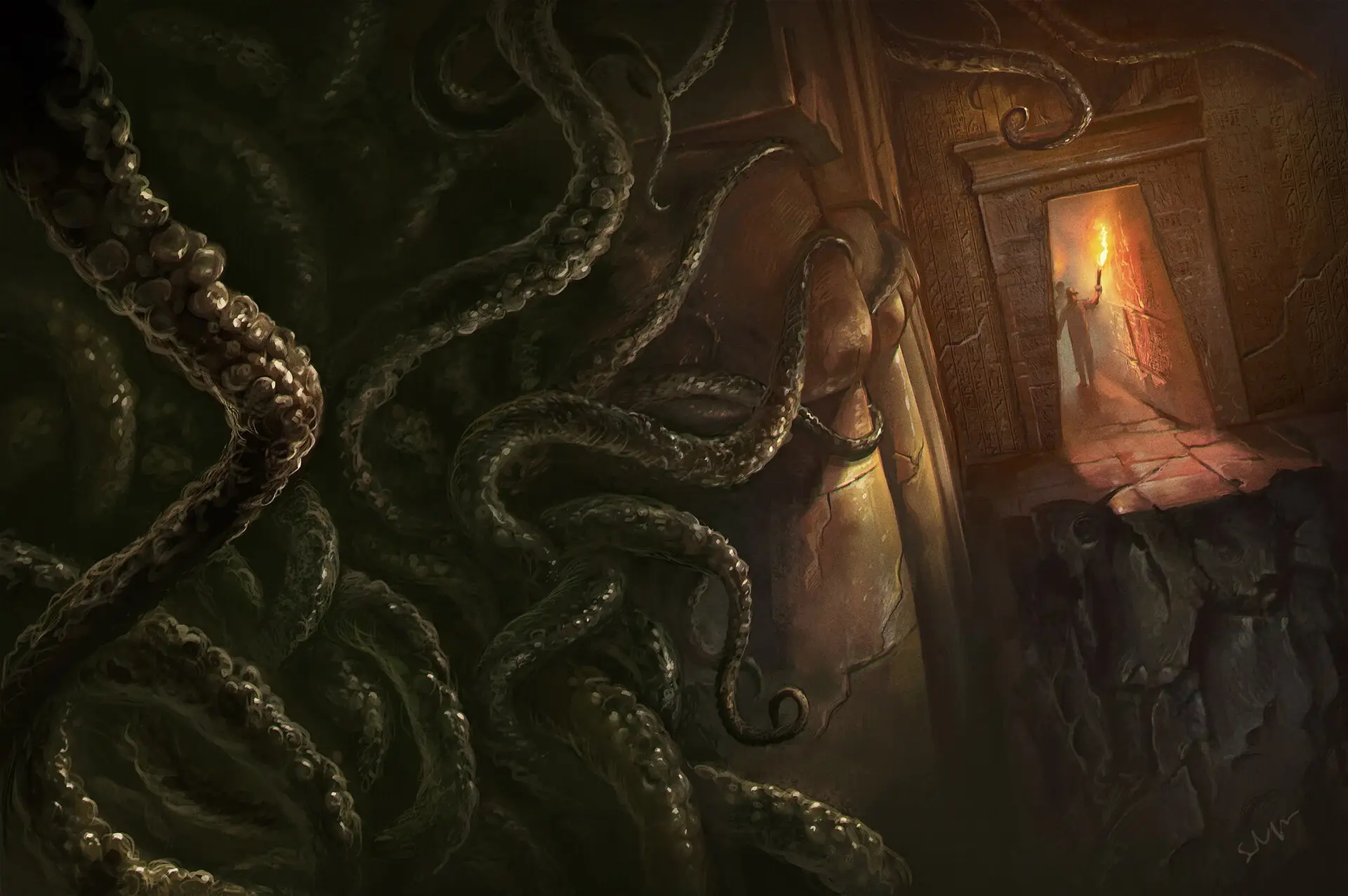
The places of the Mythos.
An invented Massachusetts town, with its newspaper, its asylum and its university. Everything is already written, which makes it the easiest setting to use.
Its library holds a copy of the Necronomicon and the university funds expeditions. The ideal excuse to send academics anywhere.
A decaying port, a marine cult and a population that looks a little too alike. The scenario writes itself the moment investigators spend a night there.
Bare hills, isolated farms and families who speak to nobody. The horror there is rural, slow and perfectly visible from the road.
A city of impossible angles, risen from the depths for a few hours. You set foot there once, and rarely to your advantage.
A parallel world entered while asleep, with its own cities, gods and dangers. The tone there is dreamlike rather than grim.
The creatures you will meet.
Immortal, amphibious and able to breed with humans. Their descendants change slowly, which makes a whole village suspect.
Masses of protoplasm able to grow any organ on demand. They were tools, and ended up devouring their makers.
They mine on Earth and carry human brains away in cylinders. Perfect for a case where nobody knows who is still human.
Builders who came long before us, found in the ice. They are mostly a lesson in humility: their civilisation is older than our species.
Once human, they live beneath the graves and remember their earlier lives. You can talk to them, which makes them far more disturbing.
They serve as mounts to cross space, if you survive the trip. Their appearance alone costs Sanity.
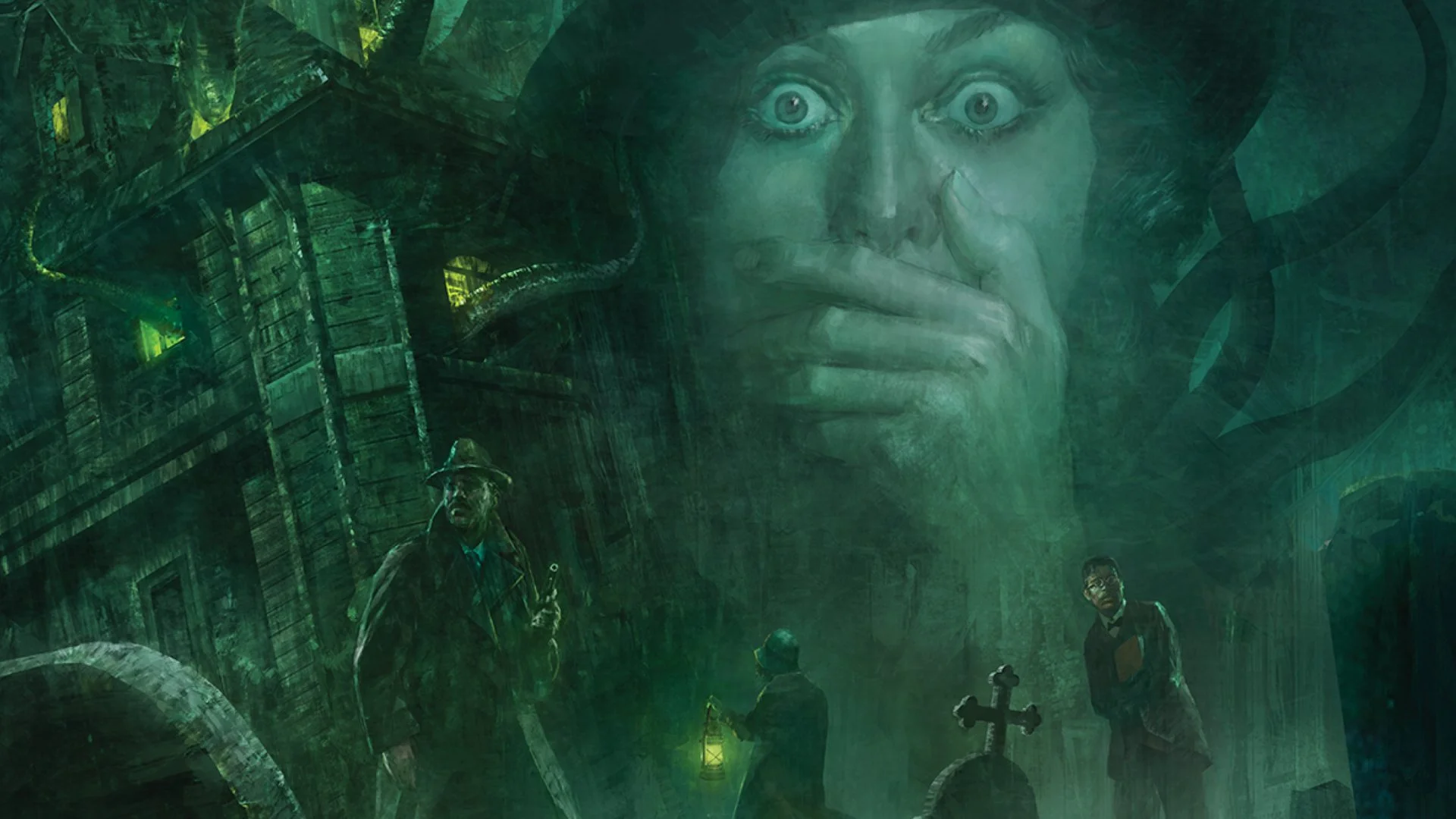
Great Old Ones and Outer Gods.
Cthulhu gives the game its name but does not sit at the top. He belongs to the Great Old Ones, physical entities out of the stars, asleep or imprisoned, and R'lyeh is the most famous of those prisons. Higher still stand the Outer Gods, shapeless and indifferent: Azathoth, the blind chaos at the centre of the universe, Yog-Sothoth, who is every gate and every key, and Shub-Niggurath, monstrous fecundity itself.
Only one of these entities takes a genuine interest in humans, which is the worst possible news: Nyarlathotep, the Crawling Chaos, who walks among us behind a thousand faces and nudges people towards their own ruin. For a Keeper he is the most useful antagonist in the Mythos, because he speaks, he manipulates and he shows himself, where Azathoth can only annihilate.
The grimoires and the cults.
The Necronomicon is the most famous book of the Mythos, credited to the mad Arab Abdul Alhazred and known mainly through the Latin translation by Olaus Wormius, of which Miskatonic University keeps a copy under lock. It is not alone: the Pnakotic Manuscripts, the Book of Eibon, Cultes des Goules and Unaussprechlichen Kulten pass from private collection to closed stacks.
Reading one of them is never free. The reader gains spells and a share of the truth about the world, and loses Sanity, sometimes more. Around these books orbit the cults, quiet societies promising power or salvation to anyone willing to hasten the return of the Great Old Ones. They, far more than the monsters, are what your investigators will be up against most of the time.
Using the Mythos at your table.
A disappearance, an inheritance, a theft: the case must stand up without the Mythos. The supernatural only arrives in act three.
A smell, a footprint too wide, a noise in the wall beat any full description. A creature seen in full light stops being frightening.
Clippings, letters and diary pages let the players make the connections. A handout on the table lands harder than a long monologue.
A cult that means to open a gate at the next new moon gives you a countdown. With no deadline, an investigation drifts on with no tension.
Leaving one question unanswered is the mark of the genre. The table should leave arguing about what they saw, not ticking off a list.
Lovecraft, Derleth and Chaosium already contradict each other. Your version of the Mythos is as legitimate as theirs.
Bringing the Mythos to life online.
An investigation lives on what your players can actually look at: a newspaper clipping, a photograph, an annotated map. Described out loud a handout stays vague. Displayed, it becomes unsettling.
Tomeus gathers the backdrop, the music, the sheets and the dice roller in a single window. You prepare your handouts ahead of time, send the link, and your players step into the investigation with nothing to install.
Go further with Call of Cthulhu.
How to Start Playing Call of Cthulhu
Free quick-start rules, percentage skills, Sanity and a first investigation: the complete guide to start playing Call of Cthulhu in one evening.
The Basic Rules of Call of Cthulhu
The d100 and the three success thresholds, the eight characteristics, bonus dice, pushed rolls, combat and Sanity: the basic rules of Cthulhu explained.
Call of Cthulhu occupations
Call of Cthulhu has no classes but occupations: antiquarian, private investigator, journalist, doctor, their skills, skill points and Credit Rating explained.
Call of Cthulhu Great Old Ones
Azathoth, Yog-Sothoth, Nyarlathotep, Cthulhu, Hastur: the Outer Gods and Great Old Ones of the Mythos, their cults and what they cost in Sanity.
Go further with tabletop RPGs.
How to Play a Tabletop RPG: the Beginner's Guide
How a session unfolds, what the game master does, dice, character sheets and how to play a tabletop RPG online. A complete guide for beginners.
How to Find Players for a Tabletop RPG
Game shops, clubs, conventions, Discord, online listings: where to find players for your tabletop RPG and how to write an ad people answer.
The Best Tabletop RPGs for Beginners
Dungeons & Dragons, Call of Cthulhu, Alien, Monster of the Week: six easy tabletop RPGs for a first session, and how to pick the right one.
How to Create a Tabletop RPG Character
Concept, class, ability scores, skills, backstory and bonds: the full method to create a tabletop RPG character who will carry a whole campaign.
Frequently asked questions.
Do you need to know the Mythos to play Call of Cthulhu?
No, and a player who knows nothing about it is often best placed: they discover it at the same time as their investigator, and the surprise works properly. Only the Keeper benefits from a few landmarks, and two or three short stories are enough. Everything else is learned by playing, scenario after scenario.
What is the difference between Great Old Ones and Outer Gods?
Great Old Ones are physical entities out of the stars, asleep or shut away somewhere on Earth or near it. Cthulhu in R'lyeh is the textbook case. Outer Gods belong to another scale entirely: Azathoth, Yog-Sothoth and Shub-Niggurath are neither located nor comprehensible, and have no reason to notice humanity at all. That classification comes mostly from August Derleth and the authors who followed, Lovecraft did not use these categories.
Where can you read the Cthulhu Mythos texts?
Lovecraft's stories are in the public domain and can be read online for free. Three of them are enough to start: The Call of Cthulhu, The Shadow over Innsmouth and The Dunwich Horror. Chaosium supplements then add creatures, spells and detailed locations, but no reading at all is required to run a game.