The lore of Warhammer 40K.
Warhammer 40K tells of a human empire spanning a million worlds, ruled in the name of an Emperor who has been dying for ten thousand years, and which has nothing heroic left about it. It is a setting of permanent war, compulsory faith and lost knowledge.
Here is that setting gathered in one place, in the order it comes up at the table. The Imperium and how it works, the institutions that hold it together, the enemies eating away at it, the civil war that broke everything, and the Warp that makes it all possible.
What is the Imperium?
The Imperium of Man binds a million worlds around a living corpse. The Emperor, mortally wounded ten thousand years ago, sits on a throne that holds him between life and death and consumes thousands of human lives every day so that ships can still find their way between stars. Nobody truly rules this empire: vast administrations share it out and watch each other.
Technology is inherited rather than invented, science has become liturgy, and asking the wrong question is enough to make a man disappear. A planet can be bled dry by tithes for centuries without anyone at the centre noticing, and wiped off the map in a night if an inquisitor decides it is lost. It is an empire too large to know itself.
The forces of the Imperium.
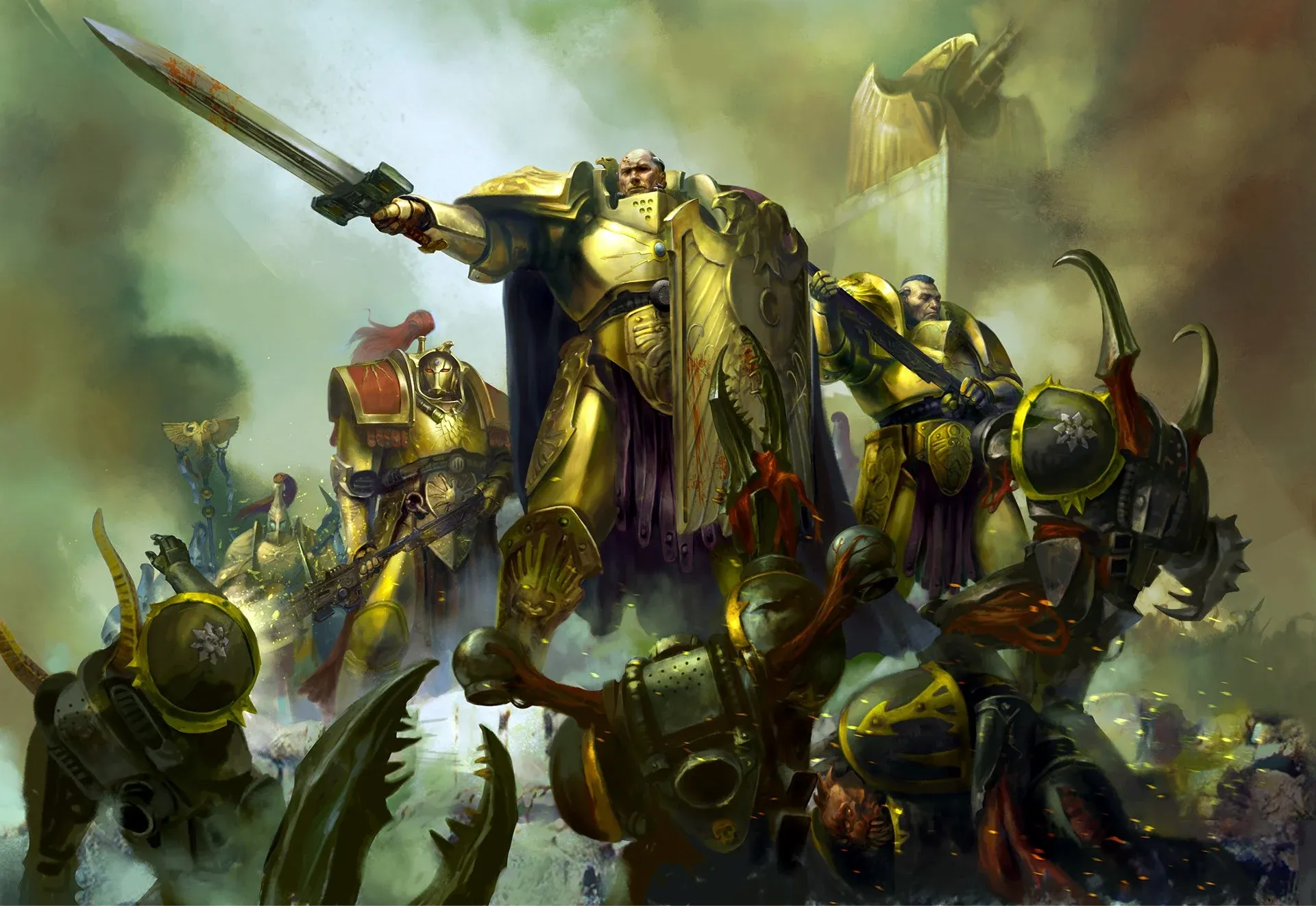
Soldiers altered until they are no longer quite human, organised into independent chapters. They are rare, and called in once everything else has failed.
Billions of ordinary soldiers, raised world by world and sent to fronts they do not return from. They actually win the wars, at a terrible price.
Its agents hunt heresy, xenos and daemons, with authority to requisition anything. An inquisitor can save a world or order it destroyed.
It holds technology and maintains it as a cult, prayers included. Without it no ship flies, and it makes that clear in every negotiation.
It teaches that the Emperor is a god and shapes the lives of billions. Its armies of battle sisters burn whatever refuses to believe.
An ocean of scribes, tithes and archives where a file can be lost for a century. Most tragedies here begin with a clerical error.
The enemies of humanity.
Four powers born of human emotion, served by traitors and daemons. It is the most intimate threat, because it always starts with a temptation.
A species that breeds by spores and lives only to fight. Funny from a distance, utterly terrifying when they arrive in their millions.
An ancient, refined people who caused their own fall. They shape the future and will trade a human world for a handful of their own without hesitating.
A swarm that crosses between galaxies and strips a world of all life before moving on. You do not negotiate, you do not flee, you delay.
A civilisation that traded flesh for metal and has slept for sixty million years. Every tomb that opens costs the Imperium a system.
A young power offering progress and prosperity to whoever joins its Greater Good. Plenty of human worlds accepted, which the Imperium never forgives.
The Heresy, the original wound.
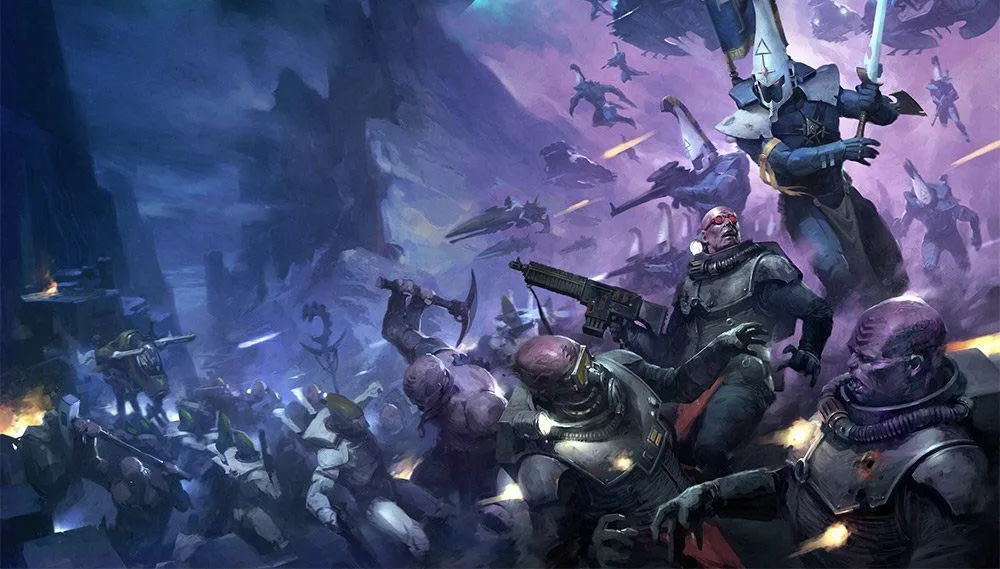
Ten thousand years ago the Emperor was reconquering the galaxy at the head of his legions, commanded by sons made in his image. One of them, Horus, turned against him and dragged half those legions into revolt. The civil war that followed ended before the throne, where the Emperor defeated his son and was mortally wounded.
Everything since flows from that moment. The loyal legions were broken into chapters so none could ever try again, the traitors withdrew into a region of space where time means nothing, and the Imperium froze in fear of its own history. Understanding the Heresy means understanding why this empire would rather burn a library than read it.
The Warp, and what lives in it.
Travelling between stars means diving into another dimension, made of the stuff of emotion and inhabited by things that think. A mutated navigator steers the ship by the light of a psychic beacon fed by the Emperor himself, and a journey can take a week or a century depending on the currents.
Some humans are born connected to that place. They are called psykers, and they are feared, recruited or executed depending on the mood, because each of them is a door something can open. Since a vast rift split the galaxy in two, half its worlds live without word from the centre, under a sky that is no longer quite their own.
Using this lore at your table.
A hive, a station, a mining moon. Your players will remember one district and three faces far better than a map of the galaxy.
A million worlds, tithes that take thirty years to arrive. Naming those numbers makes every choice the characters make small and precious.
An inquisitor, a noble, a magos, an officer. They bring the missions and call in the debts at the worst possible moment.
A quiet cult, a questionable relic, a report that does not add up. Almost every investigation here starts with an administrative detail.
This setting works when small victories cost dearly. Saving one district plays better at a table than saving a galaxy.
Forty years of publications contradict each other cheerfully. Take what serves your story and invent the sector you are missing.
Bringing the galaxy to life online.
A setting like Warhammer 40K lives on images: a cathedral of iron, a ship corridor, a plain under smoke. Describing all of it in words alone, session after session, takes energy the game master would rather spend on the plot.
Tomeus brings the backdrop, the music, the sheets and the dice into one window. You prepare your scenes ahead of time, switch image and mood in one click, and your players join from home with their character in front of them, with nothing to install.
Go further with Warhammer 40K.
How to start playing the Warhammer 40K RPG?
Wrath & Glory or Imperium Maledictum, dice, character creation and a first session: the guide to getting started with the Warhammer 40K roleplaying game.
The basic rules of Warhammer 40K
The dice and symbols of Wrath & Glory, the d100 of Imperium Maledictum, the pools, combat and corruption: the rules of the 40K roleplaying game explained.
The archetypes of Warhammer 40K
The archetypes and roles of the 40K roleplaying game explained: Space Marine, trooper, tech-priest, psyker, savant and penumbra, factions, and how to choose yours.
The Space Marines of Warhammer 40K
The Adeptus Astartes explained: the implants, the gene-seed, the chapters, the primarchs, the cost of the transformation and how to play one.
Go further with tabletop RPGs.
How to Play a Tabletop RPG: the Beginner's Guide
How a session unfolds, what the game master does, dice, character sheets and how to play a tabletop RPG online. A complete guide for beginners.
How to Find Players for a Tabletop RPG
Game shops, clubs, conventions, Discord, online listings: where to find players for your tabletop RPG and how to write an ad people answer.
How to Prepare a Tabletop RPG Campaign
Setting, central stake, factions, NPCs and per-session prep: the method to build a tabletop RPG campaign without writing everything in advance.
How to Create a Tabletop RPG Character
Concept, class, ability scores, skills, backstory and bonds: the full method to create a tabletop RPG character who will carry a whole campaign.
Frequently asked questions.
Do you need to know the lore to play Warhammer 40K?
No. Three sentences carry a first session: a vast, dying human empire, an Emperor kept alive for ten thousand years, and enemies everywhere, including within. The rest is learned by playing, mission after mission, exactly the way the characters find it out.
When in the 40K timeline are games set?
Usually in the forty first millennium, the period covered by the current lines, after the great rift split the galaxy in two. Some tables prefer to play before that event, for a more stable galaxy, and others go all the way back to the civil war at the origin of it all.
Can you play anything other than soldiers?
Yes, and that is where the setting becomes most interesting. An inquisitor's investigator, a Mechanicus tech-adept, a rogue trader, a preacher, a scribe who knows too much: a hive world offers as many plots as a battlefield, often with more tension.